The Ultimate Profitable Non Repaint Forex Strategy for Consistent Gains
Profitable Non Repaint Forex Strategy: The Comprehensive Guide to Consistent Success
In the high-stakes world of foreign exchange trading, the term “Holy Grail” is often tossed around by marketers promising 100% win rates. However, experienced traders know that the real secret to long-term profitability isn’t a magical crystal ball; it’s a profitable non repaint forex strategy. Understanding the difference between indicators that shift their history and those that provide fixed, reliable signals is the first step toward professional-grade trading.
What Does ‘Non-Repaint’ Actually Mean?
Before diving into the strategy, we must define the term. A repainting indicator is one that changes its past signals based on subsequent price action. For example, a buy arrow might appear on a chart, but if the price continues to drop, that arrow might disappear or move to a later candle. This creates a false sense of accuracy during backtesting, as the indicator looks like it perfectly predicted every move.
Conversely, a non-repaint strategy uses tools that commit to their signals once a candle closes. If a signal appears, it stays there forever, regardless of whether the trade turns into a winner or a loser. This transparency is crucial for building trust in your system and for performing accurate statistical analysis.
The Danger of the Repainting Trap
Many novice traders fall into the trap of purchasing expensive software that boasts a 90% win rate. When they look at the historical charts, the signals look impeccable. However, once they go live, they realize the signals are shifting in real-time. This leads to “revenge trading” and psychological breakdown. A non-repaint strategy eliminates this uncertainty, allowing the trader to focus on execution and risk management rather than questioning the validity of the data.
Core Components of Our Non-Repaint Strategy
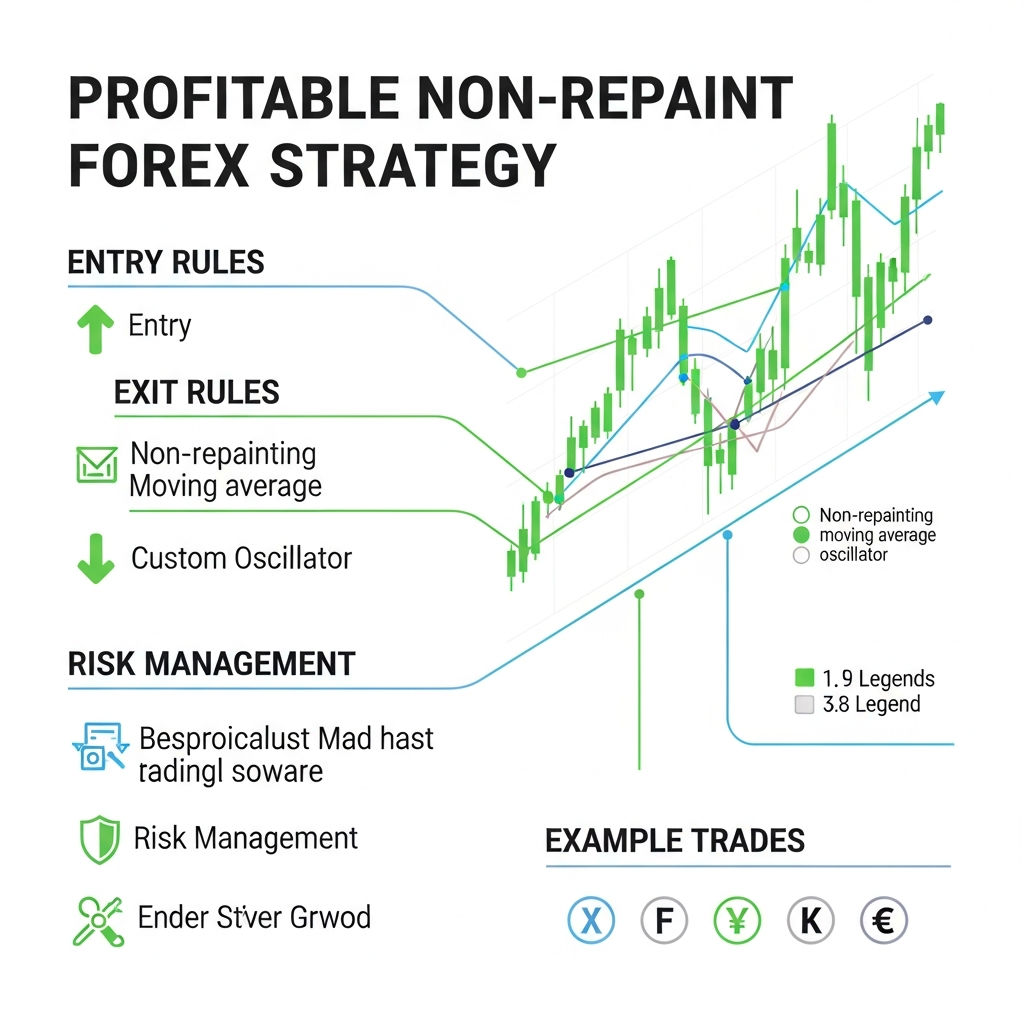
To build a robust system, we combine three distinct types of technical analysis. By layering these non-repainting elements, we create a filter that discards low-probability setups.
1. Market Structure and Price Action
Price action is the purest form of a non-repainting indicator. The high, low, open, and close of a candle are historical facts. We look for Higher Highs and Higher Lows to identify an uptrend, and Lower High Lows and Lower Lows for a downtrend. Support and resistance levels are also fundamental components that do not change once established.
2. The Exponential Moving Average (EMA) Cross
Moving averages are the bread and butter of trend following. While they are lagging indicators, they are strictly non-repainting. For this strategy, we utilize the 50-period EMA (the trend filter) and the 20-period EMA (the momentum trigger). When price is above the 50 EMA, we only look for buy opportunities.
3. The Relative Strength Index (RSI) with a Neutral Zone
The RSI is a momentum oscillator. To ensure it remains non-repainting and effective, we avoid using it for overbought/oversold extremes in isolation. Instead, we look for RSI crossovers of the 50-level mid-line to confirm momentum shifts in the direction of the trend.
The Strategy Blueprint: Step-by-Step Rules
This strategy is designed for the 1-hour (H1) and 4-hour (H4) timeframes, which offer a balance between frequent signals and reduced market noise.
The Buy Setup (Long Position)
- Trend Confirmation: The price must be trading above the 50 EMA.
- Momentum Alignment: The 20 EMA must cross above the 50 EMA (The Golden Cross).
- Oscillator Confirmation: The RSI must be above the 50 level.
- Price Action Trigger: Wait for a bullish engulfing candle or a pin bar rejection at the 20 EMA.
- Entry: Enter at the close of the trigger candle.
The Sell Setup (Short Position)
- Trend Confirmation: The price must be trading below the 50 EMA.
- Momentum Alignment: The 20 EMA must cross below the 50 EMA (The Death Cross).
- Oscillator Confirmation: The RSI must be below the 50 level.
- Price Action Trigger: Wait for a bearish engulfing candle or a pin bar rejection at the 20 EMA.
- Entry: Enter at the close of the trigger candle.
Risk Management: The Pillar of Profitability
Even the most profitable non repaint forex strategy will fail without strict risk management. No indicator can predict black swan events or sudden geopolitical shifts. Therefore, every trade must have a predetermined exit point.
Stop Loss Placement: Place your stop loss 5-10 pips below the recent swing low (for buys) or above the recent swing high (for sells). Alternatively, use the Average True Range (ATR) indicator to set a volatility-based stop loss.
Take Profit Targets: We recommend a minimum Risk-to-Reward ratio of 1:1.5 or 1:2. This means if you are risking 20 pips, your target should be at least 30 to 40 pips. You can also use a trailing stop to capture extended trend moves.

Advanced Filtering: Avoiding the “Chop”
One weakness of any trend-following non-repaint strategy is a ranging (sideways) market. During these periods, moving averages flatten out and RSI oscillates around the 50 level, producing “whipsaws.”
To avoid this, look at the angle of the 50 EMA. If the EMA is horizontal, the market lacks direction—stay out. If the EMA is angled sharply upward or downward, the trend is strong, and signals are high-probability. Furthermore, check the economic calendar. Avoid entering new trades 30 minutes before and after high-impact news releases like the Non-Farm Payroll (NFP) or Interest Rate decisions.
The Importance of Backtesting
Because this strategy is non-repainting, you can manually scroll back through your charts and see exactly where signals would have occurred. We recommend backtesting at least 100 setups across different currency pairs (like EUR/USD, GBP/JPY, and AUD/USD) before going live. Record the win rate, the maximum drawdown, and the average profit per trade. This data provides the psychological confidence needed to execute the strategy during a losing streak.
Psychology and Discipline
The biggest hurdle in forex trading is the human element. A non-repaint strategy provides a clear set of rules, but the trader must follow them. Fear of missing out (FOMO) often leads traders to enter before a candle closes. Greed causes them to move take-profit levels further away, only to watch the market reverse. Discipline is the bridge between a strategy on paper and profits in a bank account.
Conclusion: Building Your Trading Career
A profitable non repaint forex strategy is not a get-rich-quick scheme. It is a professional tool that requires patience, practice, and precise execution. By combining the 50/20 EMA cross with RSI momentum and solid price action principles, you create a system that is grounded in market reality, not mathematical illusions.
Remember that trading is a marathon, not a sprint. Focus on the process of identifying valid, non-repainting setups and managing your risk meticulously. Over time, the mathematical edge of the strategy will manifest in a growing equity curve. Start on a demo account today, master the nuances of the EMA and RSI relationship, and take control of your financial future in the forex market.
Summary Checklist for the Strategy:
- Is the price on a clear trend relative to the 50 EMA?
- Has the 20 EMA confirmed momentum?
- Is the RSI in agreement with the trend direction?
- Is there a clear price action trigger (Pin Bar/Engulfing)?
- Is the Risk-to-Reward ratio at least 1:1.5?
If the answer to all these questions is ‘Yes,’ you have a high-probability trade setup. Happy trading!