FTMO Challenge Strategy 2026: The Ultimate Guide to Passing and Scaling
Introduction: The Landscape of Prop Trading in 2026
As we navigate through 2026, the world of proprietary trading has evolved into a sophisticated ecosystem where technology and human intuition must work in perfect harmony. The FTMO Challenge remains the industry benchmark, but the strategies required to pass it have shifted from simple technical analysis to a multi-dimensional approach involving AI-assisted data and rapid execution models. In 2026, the competition is fiercer, the markets are more algorithmic, and the need for a robust FTMO challenge strategy 2026 has never been more critical for aspiring professional traders.
To succeed in the current market environment, traders must move beyond the basics. It is no longer just about knowing where to place a stop loss; it is about understanding institutional liquidity, managing drawdown through automated safety nets, and maintaining psychological equilibrium in a high-frequency world. This guide provides a comprehensive roadmap for conquering the FTMO Evaluation Process in 2026.
Understanding the 2026 FTMO Challenge Rules
Before diving into specific strategies, it is essential to understand the current parameters of the FTMO Challenge as of 2026. While the core philosophy remains—identifying disciplined and profitable traders—the nuances of the trading objectives have been refined to account for higher market volatility.
Phase 1: The Evaluation
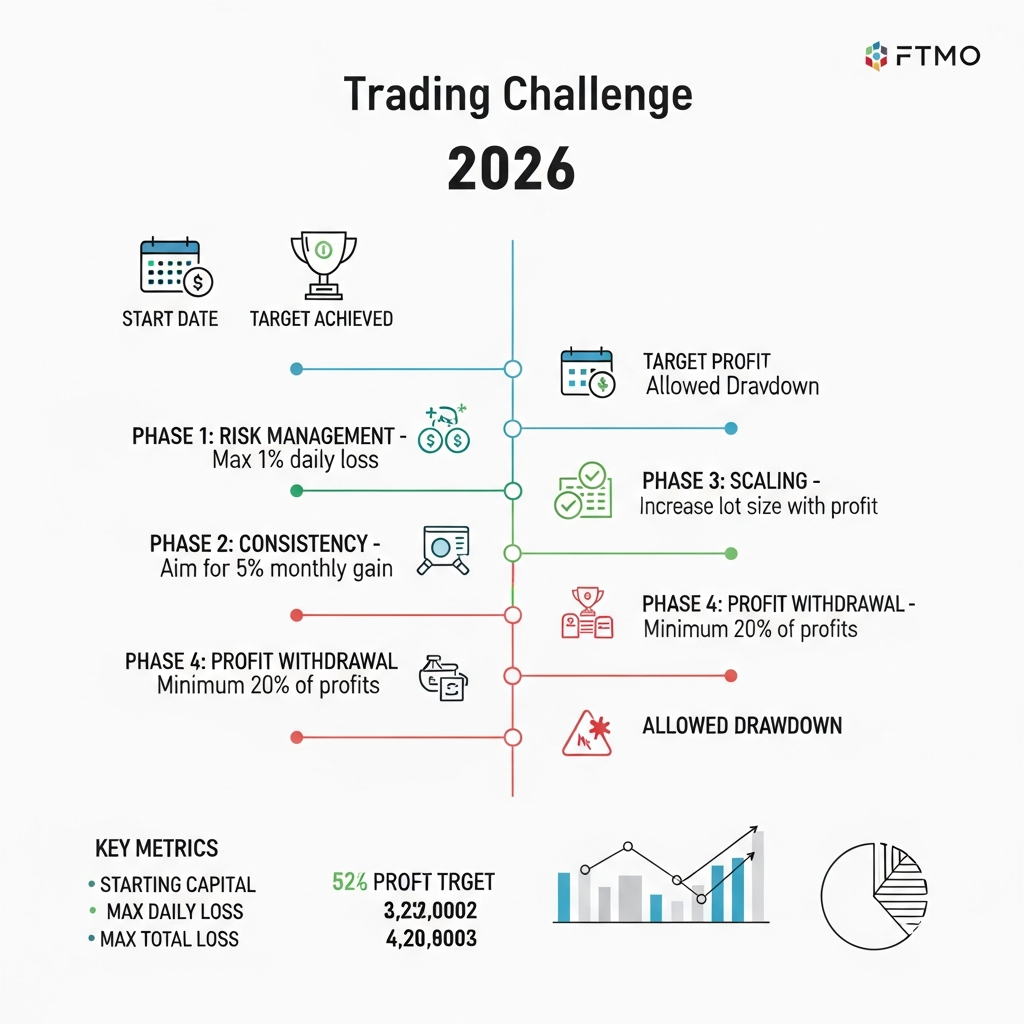
In 2026, Phase 1 still requires a 10% profit target with a maximum daily loss of 5% and a total maximum loss of 10%. However, with the 2026 update, FTMO has introduced more flexibility in terms of the trading period, often allowing unlimited days to reach the target, provided the loss limits are never breached. This shifts the strategy from ‘aggressive sprinting’ to ‘calculated endurance.’
Phase 2: Verification
The Verification phase usually halves the profit target to 5%. In 2026, successful traders treat Phase 2 as a test of consistency. The biggest mistake in 2026 is over-leveraging in Phase 2 due to overconfidence from Phase 1. A sustainable strategy involves lowering risk-per-trade during this stage to ensure the account is protected while slowly chipping away at the profit goal.
Core FTMO Challenge Strategy 2026: The Hybrid Approach
The most successful strategy in 2026 is the Hybrid Flow Model. This combines classical price action with real-time AI sentiment analysis. Here is how to break it down:
1. Smart Money Concepts (SMC) & Liquidity Probing
In 2026, retail patterns like simple head-and-shoulders are frequently used as liquidity traps by institutional algorithms. Your strategy must focus on ‘Liquidity Sweeps’ and ‘Fair Value Gaps’ (FVG). Look for areas where retail stop losses are clustered, wait for the ‘sweep’ (the false breakout), and enter when the market structure shifts on a lower timeframe. This ensures you are trading with the banks, not against them.
2. AI-Assisted Filter Strategy
By 2026, most professional FTMO traders use secondary AI filters to validate their trades. This doesn’t mean using a ‘black box’ bot, but rather using tools that analyze the 2026 ‘News Sentiment Index.’ If your technical setup is ‘Long’ on EUR/USD, but the AI sentiment is ‘Strongly Bearish’ due to central bank digital currency (CBDC) fluctuations, you skip the trade. This integration of data is a hallmark of the 2026 trading era.
Advanced Risk Management: The 0.5% Rule
In 2026, volatility is the biggest ‘account killer.’ To pass the FTMO challenge, your risk management must be surgical. We recommend the Fixed 0.5% Risk Strategy.
By risking only 0.5% of your initial balance per trade, you can endure a 10-trade losing streak and only be down 5%—well within the maximum loss limit. This gives you the ‘mathematical breathing room’ to stay in the game. In 2026, the focus is on the ‘Sharpe Ratio’ of your challenge; FTMO looks for a smooth equity curve rather than erratic spikes.
Dynamic Position Sizing
Utilize 2026 position-sizing software that automatically adjusts your lot size based on current ATR (Average True Range). Since volatility in 2026 can double within a single trading session, static lot sizes are dangerous. Your strategy should involve software that calculates the exact lot size to ensure that regardless of the stop-loss distance, the risk remains exactly 0.5%.
Sector Selection for 2026: What to Trade?
Not all instruments are equal in 2026. For the FTMO challenge, you need liquidity and predictable volume.
- Indices (US30, NAS100): High volatility, perfect for the New York session. In 2026, these are heavily influenced by AI-sector earnings.
- Major FX Pairs (EUR/USD, GBP/USD): These remain the most stable for the FTMO challenge due to low spreads.
- Commodities (Gold): Gold in 2026 serves as the primary hedge against digital asset volatility. It is excellent for ‘Swing’ accounts but requires wider stop losses.

The Psychology of Trading in 2026
Psychological resilience is the ‘hidden’ part of any FTMO challenge strategy 2026. With the rise of social media ‘fin-fluencers’ showcasing massive gains, the pressure to pass quickly is immense. In 2026, the best traders practice ‘Digital Isolation.’ This involves:
1. The No-Comparison Rule
Focus entirely on your equity curve. In 2026, the FTMO dashboard provides advanced analytics; use these to compete against your own past performance, not against others on the leaderboard.
2. Managing ‘Drawdown Stress’
Drawdown is inevitable. In 2026, successful traders use ‘Micro-Breaks.’ If you lose two trades in a row, the strategy dictates a mandatory 4-hour logout. This prevents ‘revenge trading,’ which remains the leading cause of failed FTMO challenges even in 2026.
Technical Setup: Tools for the 2026 Trader
To execute a top-tier FTMO challenge strategy 2026, your workstation needs to be optimized for speed and data. The 2026 standard includes:
- Low-Latency VPS: Even if you trade manually, executing via a Virtual Private Server (VPS) ensures your orders reach the FTMO servers with millisecond precision, avoiding slippage.
- Multi-Timeframe Correlation Matrix: A tool that shows you how the DXY (Dollar Index) is moving in relation to your trade pair in real-time.
- Journaling 4.0: Use automated journaling software that records not just your entry/exit, but your heart rate (via wearable tech integration) and screen recording for post-trade analysis.
Step-by-Step Execution Plan for Your 2026 Challenge
Week 1: Defensive Play
Focus on high-quality setups only. Aim for a 1-2% gain. Do not rush. In the 2026 market, the first week is about ‘feeling’ the current market regime (Trending vs. Ranging).
Week 2: Capitalizing on Trends
Once you are in a small profit, you can slightly increase your frequency (not your risk). Look for ‘Trend Continuations’ using the 2026 EMA Ribbon Strategy. Aim to reach 5-6% total profit by the end of week 2.
Week 3: The Final Push
If you are near the 10% target, the psychological pressure increases. This is where many fail. The 2026 strategy here is to ‘Scale Down.’ If you need 1.5% more to pass, do not try to get it in one trade. Break it into three 0.5% trades.
Common Pitfalls to Avoid in 2026
Despite the advanced tools available, traders still fail the FTMO challenge for age-old reasons, exacerbated by 2026 conditions:
- Overtrading the News: 2026 news events are highly volatile due to algorithmic reactions. Avoid trading 30 minutes before and after high-impact folder events unless you are on a ‘Swing’ account.
- Ignoring the Daily Loss Limit: Most traders focus on the 10% total loss but get caught by the 5% daily limit during a volatile reversal.
- Neglecting Sleep and Health: In the 24/7 digital economy of 2026, trader burnout is at an all-time high. A tired brain cannot calculate complex risk-to-reward ratios.
Conclusion: Your Path to Becoming a Funded Trader
Passing the FTMO challenge in 2026 requires a blend of discipline, modern technology, and a deep understanding of market mechanics. By implementing a FTMO challenge strategy 2026 that prioritizes risk management through the 0.5% rule, utilizes AI-filtered sentiment, and focuses on institutional liquidity, you position yourself in the top 1% of traders.
Remember, the goal is not just to pass the challenge, but to keep the funded account. The habits you build during the 2026 evaluation—meticulous journaling, emotional control, and technical precision—will be the foundation of your career as a professional prop trader in the years to come. Stay focused, stay disciplined, and let the 2026 market opportunities work in your favor.