Mastering Machine Learning Forex Indicators: The Ultimate 2026 Guide
The Paradigm Shift: Machine Learning Forex Indicators in 2026
As we navigate through 2026, the landscape of the foreign exchange market has undergone a radical transformation. Gone are the days when retail and institutional traders relied solely on static, lagging indicators like the 14-period RSI or standard Bollinger Bands. Today, the dominance of machine learning forex indicators has redefined technical analysis, shifting the focus from historical observation to predictive intelligence.
The complexity of the global economy in 2026—characterized by rapid digital asset integration, decentralized finance (DeFi) liquidity bridges, and high-frequency geopolitical shifts—demands tools that can learn and adapt in real-time. Machine learning (ML) indicators do exactly that. Unlike traditional math-based formulas, these indicators utilize neural networks and probabilistic models to identify patterns that are invisible to the human eye and traditional software.
Why 2026 is the Year of the ML Trader
By 2026, the volume of data generated by global markets has reached petabyte scales every hour. Standard indicators simply cannot process the non-linear relationships found in modern order flow and sentiment data. Machine learning forex indicators provide a competitive edge by filtering noise and identifying high-probability ‘regime shifts’ before they manifest as price action.
Core Technologies Powering 2026 Indicators
To understand why these tools are so effective in the current market, we must look at the underlying architectures that have become the industry standard this year.
1. Recurrent Neural Networks (RNN) and LSTM
Long Short-Term Memory (LSTM) networks remain the backbone of time-series forecasting in 2026. These models are uniquely suited for Forex because they have a ‘memory’ of past price movements, allowing them to understand the context of a current trend relative to historical cycles. In 2026, advanced LSTM indicators are now capable of multi-step forecasting, predicting not just the direction but the duration of a trend.
2. Transformer-Based Price Prediction
Originally designed for natural language processing, Transformer models have been adapted for financial time-series data. By 2026, ‘Attention’ mechanisms allow indicators to weigh different historical events differently. For example, a Transformer-based indicator might ignore the volatility of the past hour if it recognizes a structural pattern similar to a central bank announcement from three months ago.
3. Reinforcement Learning (RL) Agents
Reinforcement learning has evolved from a research curiosity into a practical indicator tool. RL-based indicators treat the market as an environment and learn an optimal ‘policy’ for signaling. These indicators don’t just tell you the price might go up; they provide a confidence score based on millions of simulated trades performed in similar market conditions.
Top Machine Learning Forex Indicators to Use in 2026
In 2026, the following indicators have emerged as the gold standard for professional traders. Many are now integrated directly into modern trading platforms or available via custom API connectors.
1. The Neural Adaptive Moving Average (NAMA)
The NAMA is a 2026 evolution of the traditional EMA. It uses a small neural network to dynamically adjust its smoothing factor based on current market volatility and fractal dimension. When the market is range-bound, the NAMA flattens significantly to avoid whip-saws; during a breakout, it accelerates faster than any traditional moving average to capture the core move.
2. NLP-Sentiment Weighted Oscillators
By 2026, price action alone is insufficient. The most successful indicators now incorporate Natural Language Processing (NLP). These oscillators scrape real-time data from financial news, social media, and central bank transcripts. If the price is rising but the ‘Sentiment Index’ is divergence-bearish due to negative news flow, the indicator warns of a ‘fake-out’ with high accuracy.
3. Regime-Switching Hidden Markov Models (HMM)
One of the hardest things for a trader is identifying when a market shifts from ‘Trending’ to ‘Mean-Reverting.’ HMM indicators in 2026 automatically classify the current market state into one of four or five ‘regimes.’ This allows traders to switch their underlying strategy automatically, preventing the heavy losses usually incurred when a trend-following system hits a sideways market.
4. Autoencoder Denoising Filters
Standard filters like the Heikin-Ashi often lag too much. In 2026, traders use Autoencoders—a type of neural network—to ‘denoise’ the price feed. These indicators reconstruct the price action by stripping away high-frequency noise that doesn’t contribute to the underlying trend, providing a crystal-clear view of the institutional ‘smart money’ direction.
How to Integrate ML Indicators into Your Trading Strategy
Building a strategy in 2026 requires more than just dragging an indicator onto a chart. It requires a holistic approach to data and risk.
Step 1: Data Normalization and Preparation
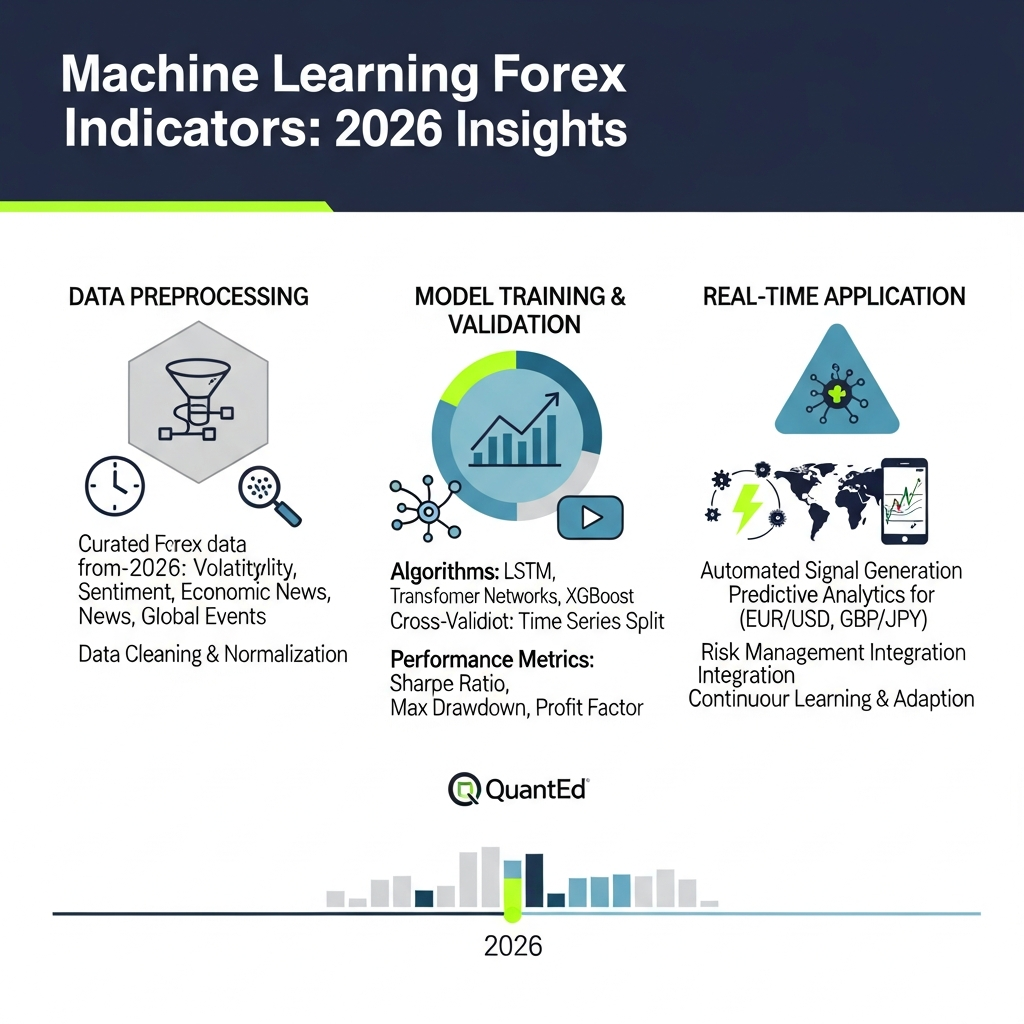
Machine learning models are sensitive to the scale of input data. In 2026, most advanced platforms handle this automatically, but if you are coding your own indicators in Python, you must ensure your price data is normalized (usually via Z-score or Min-Max scaling) to ensure the neural network doesn’t become biased toward high-nominal-value pairs like GBP/JPY compared to EUR/USD.
Step 2: Walk-Forward Optimization
Overfitting remains the biggest enemy of ML indicators. In 2026, the standard practice is ‘Walk-Forward Optimization.’ This involves training the indicator on a set of data, testing it on the subsequent period, and then rolling that window forward. This ensures the indicator stays relevant to the 2026 market dynamics rather than just ‘memorizing’ the past.
Step 3: Multi-Indicator Confluence
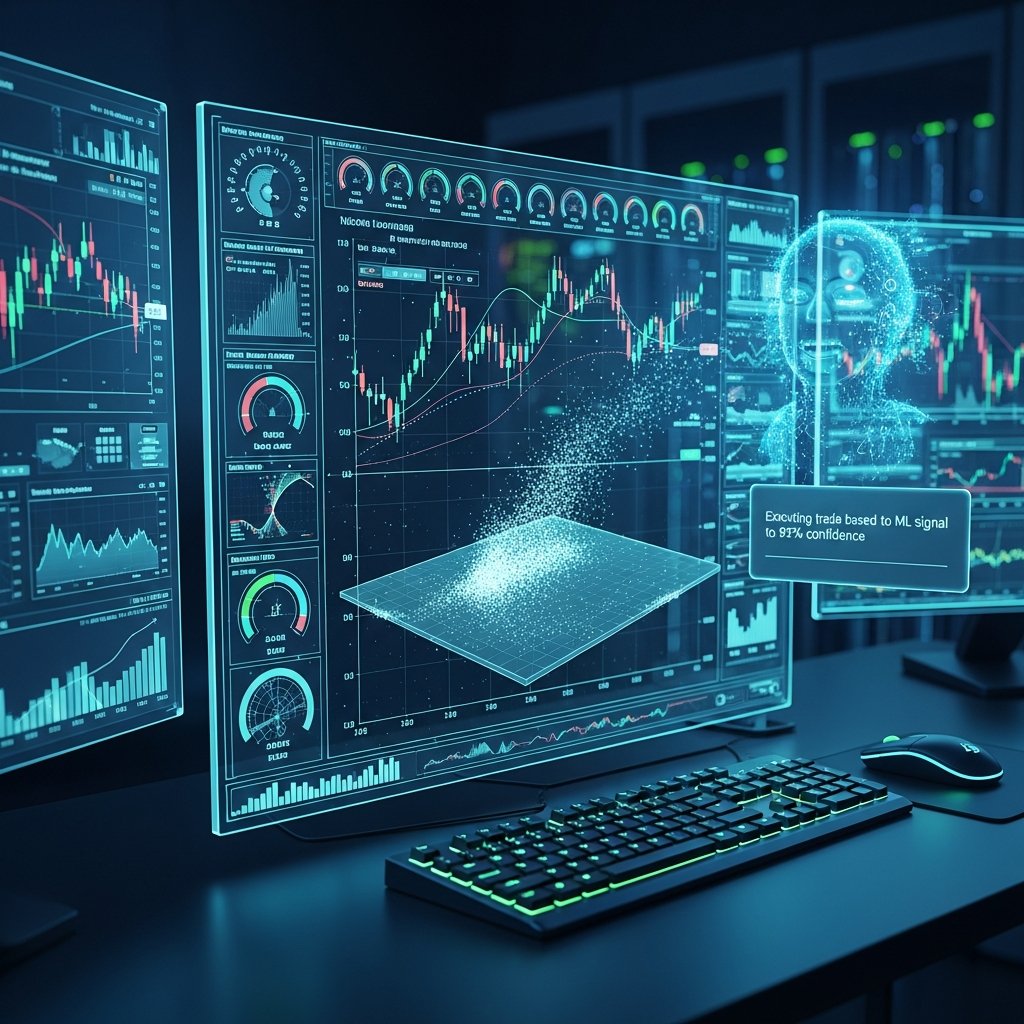
Even in 2026, no single indicator is a magic bullet. The most profitable strategies use a ‘Voting’ system. For instance, a trade is only executed if the LSTM Trend Indicator, the NLP Sentiment Index, and the HMM Regime Filter all agree on the direction. This ensemble approach significantly reduces drawdowns.
The Risks of AI and ML in 2026 Trading
While machine learning forex indicators are powerful, they are not without risks. Traders in 2026 must be aware of the following pitfalls:
- The Black Box Problem: Deep learning models can be difficult to interpret. You might receive a ‘Buy’ signal without knowing exactly why. Using ‘Explainable AI’ (XAI) tools is a growing trend in 2026 to solve this issue.
- Model Decay: A model that worked in the first quarter of 2026 might fail in the second quarter if a major global event changes the underlying market structure. Constant retraining is mandatory.
- Data Snooping Bias: It is easy to accidentally include future data in your training set, leading to indicators that look perfect in backtests but fail in live 2026 markets.
The Future Beyond 2026: Quantum ML Indicators
As we look toward the end of 2026 and into 2027, the first wave of Quantum Machine Learning (QML) indicators is starting to appear. These utilize quantum computing principles to process multi-variable correlations at speeds impossible for classical computers. While currently limited to top-tier hedge funds, QML represents the next frontier in the evolution of forex indicators.
Conclusion: Adapting to the New Reality
In 2026, the barrier to entry for using machine learning forex indicators has dropped, while the ceiling for potential profit has risen. Whether you are using a simple Neural Moving Average or a complex Transformer-based sentiment model, the key to success lies in understanding the logic behind the tool and managing the inherent risks of algorithmic trading.
The era of manual, intuition-based technical analysis is rapidly closing. To thrive in the 2026 forex market, traders must embrace these machine learning tools, not as replacements for strategy, but as the high-powered engines that drive them toward consistent alpha in an increasingly complex financial world.