Mastering Automated Risk Management MT4 Scripts: The 2026 Definitive Guide
Introduction: The New Era of Trading in 2026
As we move deeper into 2026, the financial markets have evolved into a high-velocity landscape where precision is no longer an advantage—it is a requirement for survival. For retail and institutional traders alike, the MetaTrader 4 (MT4) platform remains a foundational pillar, despite its age. However, the way we interact with it has fundamentally shifted. The most significant advancement this year has been the widespread adoption of automated risk management MT4 scripts.
In 2026, manual risk calculation is increasingly viewed as an obsolete practice. With market volatility driven by quantum computing algorithms and instant global news dissemination, a trader’s reaction time must be measured in milliseconds. Automated scripts provide the necessary bridge between human strategy and mechanical execution, ensuring that every trade adheres to a strict mathematical framework before it ever hits the order book.
Why Automated Risk Management is Mandatory in 2026
The trading environment of 2026 is characterized by ‘flash liquidity’ events and AI-driven sentiment shifts. Standard stop-losses and manual lot sizing are often insufficient to protect capital against these rapid movements. Automated risk management scripts offer several critical advantages that have become indispensable this year:
1. Elimination of Cognitive Bias
Even the most disciplined traders are susceptible to ‘revenge trading’ or ‘fear of missing out’ (FOMO). In 2026, advanced scripts are designed to lock a user out of the terminal if a daily drawdown limit is reached. This hard-coded discipline prevents emotional decision-making from eroding a lifetime of gains.
2. Instantaneous Position Sizing
Calculating the correct lot size based on a 1.5% risk profile while considering current account equity, leverage, and stop-loss distance can take 10-15 seconds manually. In 2026, a script performs this calculation and executes the order in under 10 milliseconds. This ensures that you get the entry price you intended without suffering from slippage during the calculation phase.
3. Dynamic Correlation Management
Modern MT4 scripts in 2026 do more than look at a single pair. They analyze the trader’s entire portfolio in real-time. If you are already long on EUR/USD, the script might prevent or reduce the risk on a GBP/USD buy setup to avoid over-exposure to US Dollar weakness, effectively managing basket risk automatically.
Key Features of 2026 MT4 Risk Management Scripts
The scripts available today are far more sophisticated than the basic ‘one-click’ tools of the early 2020s. If you are looking to upgrade your toolkit in 2026, these are the features you should prioritize:
AI-Powered Volatility Adaptation
The standout feature of 2026 is the integration of light-weight machine learning modules within MQL4 code. These scripts analyze the Average True Range (ATR) over the last 48 hours and suggest (or automatically set) a stop-loss distance that is statistically outside of market ‘noise.’ This reduces the frequency of being stopped out by minor fluctuations before the main move occurs.
The ‘Equity Guard’ Protocol
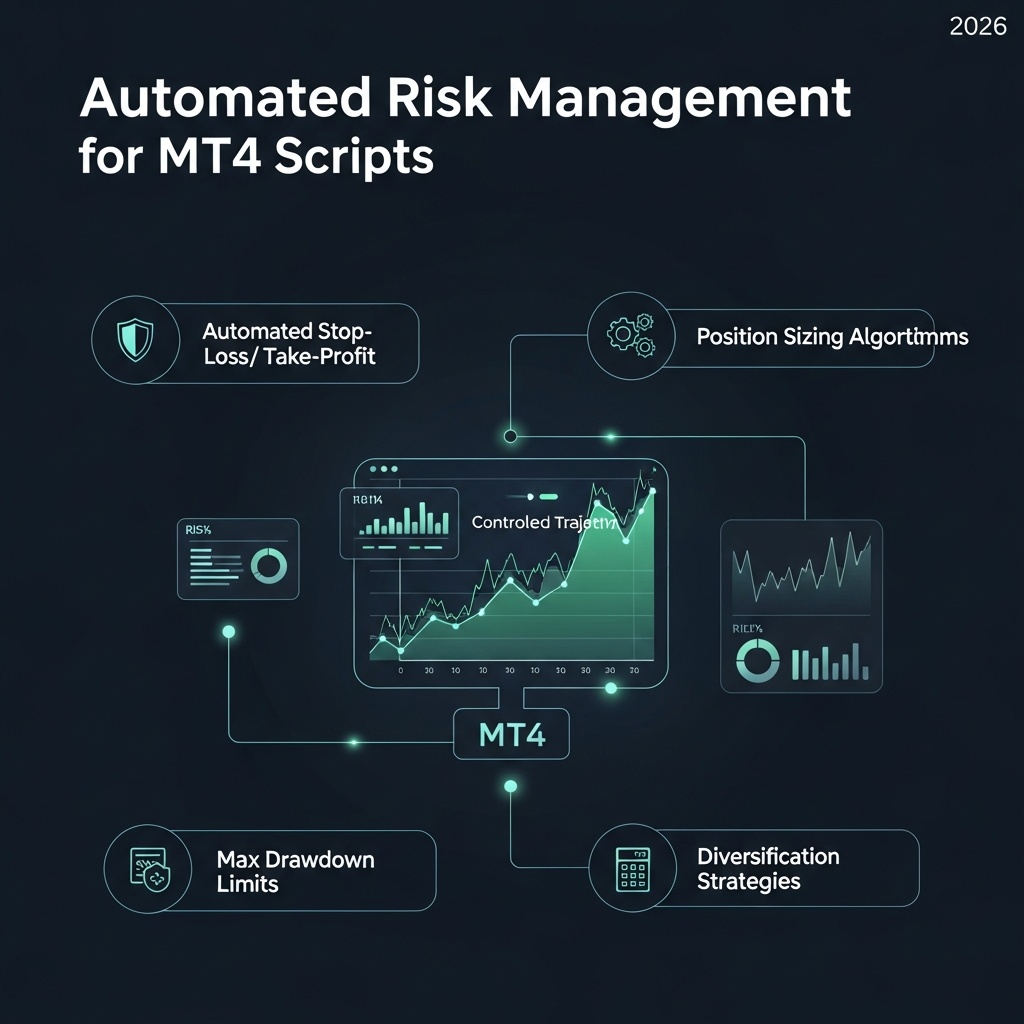
This is a failsafe mechanism that monitors the total account equity rather than just individual trades. If the total open floating loss exceeds a predefined percentage of the total balance, the script triggers a ‘global close,’ flattening all positions to preserve the remaining capital. In the volatile markets of 2026, this feature has saved countless accounts during unexpected geopolitical shifts.
Stealth Stop-Loss and Take-Profit
To combat the rise of high-frequency predatory algorithms that ‘hunt’ visible retail stop-losses, 2026 MT4 scripts often utilize ‘stealth’ modes. These scripts keep the SL and TP levels locally on the client-side or on a private VPS, only sending the ‘close’ command to the broker’s server when the price is hit. This prevents your levels from appearing in the broker’s order book.

Step-by-Step Guide: Implementing Automated Risk Management in 2026
Setting up your MT4 environment for high-level risk automation is straightforward but requires attention to detail. Follow this updated 2026 workflow to ensure your scripts are functioning correctly.
Step 1: Selecting the Right Script
Ensure your script is compatible with the 2026 build of MT4. Many legacy scripts from 2026 or earlier lack the necessary security patches and optimization for modern high-speed data feeds. Look for scripts that offer ‘Object-Oriented’ structures which are more stable during heavy market load.
Step 2: Configuration of Global Variables
Before dragging the script onto a chart, you must define your risk parameters. In 2026, best practices suggest:
- Risk Per Trade: 0.5% to 1.5% for most retail accounts.
- Max Daily Loss: 3% to 5% total equity.
- Slippage Tolerance: Adjusted for the specific liquidity of the pair.
Step 3: VPS Deployment
For automated risk management to be effective, it must be ‘always on.’ In 2026, most traders use ultra-low latency VPS providers located in proximity to the broker’s trade servers (typically London, New York, or Tokyo). This ensures that trailing stops and equity guards execute even if your local internet connection fails.
The Psychology of Automation: A 2026 Perspective
A common misconception in 2026 is that automation makes trading ‘easy.’ In reality, automation shifts the trader’s role from a ‘soldier’ to a ‘general.’ While the script handles the tactical execution and risk calculation, the trader must still provide the strategic direction.
The psychological relief provided by automated risk management cannot be overstated. When a trader knows that their maximum loss is hard-capped by a script that cannot be reasoned with or ignored, their ability to remain objective increases exponentially. This mental clarity is what separates the professional 1% from the struggling majority in today’s market.
Common Pitfalls to Avoid
Even with the best technology available in 2026, errors can occur. Be mindful of these common mistakes:
- Over-Reliance on Default Settings: Every trading strategy requires different risk parameters. A scalping script should not use the same settings as a swing trading script.
- Ignoring Latency: If your script has a 200ms delay to the server, your risk management is compromised. Always monitor your connection speed in the bottom right corner of the MT4 terminal.
- Neglecting Backtesting: Use the MT4 Strategy Tester (or the newer 2026 visual backtesting suites) to see how your risk script would have handled historical periods of extreme volatility.
Future Trends: What’s Next After 2026?
As we look toward 2027 and beyond, the integration between MT4 and decentralized finance (DeFi) data feeds is expected to grow. We are already seeing the first ‘cross-chain’ risk management scripts that allow traders to hedge their MT4 forex positions with real-time crypto assets automatically. The boundary between different asset classes is blurring, and automated scripts are the tools that allow us to navigate this unified financial world.
Conclusion: Securing Your Trading Future
Automated risk management MT4 scripts are no longer a luxury—they are the standard operating procedure for any serious trader in 2026. By offloading the mathematical and emotional burden of risk to a well-coded script, you free your mind to focus on what actually matters: identifying high-probability setups and refining your overall strategy.
The markets will always be uncertain, but your risk shouldn’t be. Whether you are using AI-driven lot sizing or stealth stop-losses, the goal remains the same: to stay in the game long enough for your edge to play out. Invest in high-quality automation today, and ensure that your trading business is still thriving in 2027 and the years to follow.