
Grid Trading EA vs Martingale Strategy: A 2026 Comparison for Algorithmic Traders
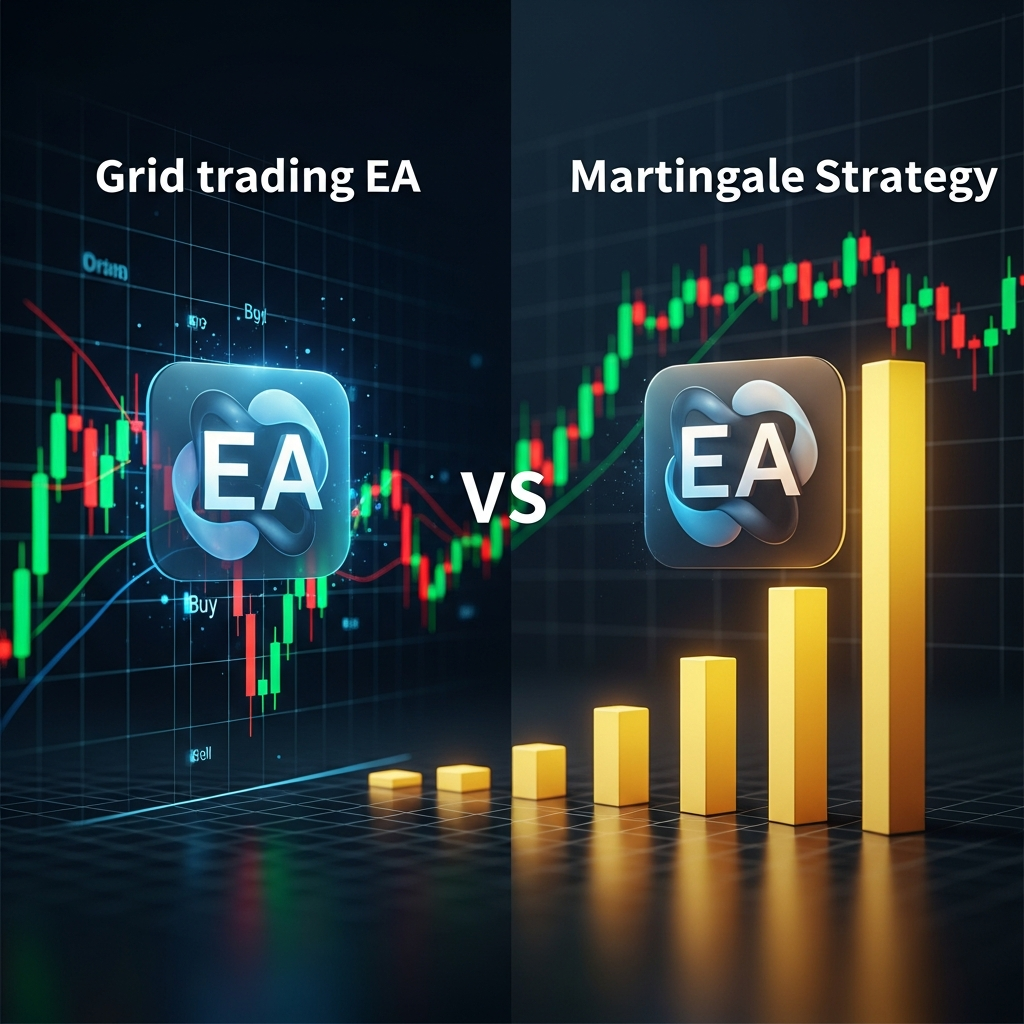
The Evolution of Automated Trading in 2026
As we navigate the financial landscapes of 2026, the reliance on automated systems—specifically Expert Advisors (EAs)—has reached an all-time high. Retail and institutional traders alike are moving away from manual discretionary trading in favor of rules-based systems that can navigate the hyper-liquid, 24/7 markets. Among the most popular frameworks used by algorithmic traders are Grid Trading and the Martingale strategy.
While both methods rely heavily on mathematical progressions rather than complex fundamental analysis, they operate on fundamentally different philosophies regarding risk and market behavior. To the uninitiated, they might look similar because they both involve multiple open positions. However, the difference between a well-calibrated Grid EA and a classic Martingale system is often the difference between steady portfolio growth and a catastrophic margin call. This article provides an authoritative breakdown of these two giants of the automated trading world.
Understanding the Grid Trading EA: Profit in Ranging Markets
Grid trading is a technique where an EA places a series of buy and sell orders at regular intervals above and below a predefined price level. This creates a ‘grid’ of orders that essentially traps the price movement. The core philosophy of a grid system is that price oscillates; it rarely moves in a straight line forever without some degree of retracement.
The Mechanics of the Grid
In a typical Grid EA, the software ignores ‘direction’ in the traditional sense. Instead of trying to predict if the market will go up or down, the grid assumes that as long as the market moves, it will eventually hit the predefined take-profit levels. In 2026, advanced Grid EAs use dynamic spacing, adjusting the distance between ‘rungs’ based on current market volatility (ATR).
- Neutral Grids: These place both buy and sell orders simultaneously, profiting from any movement regardless of direction.
- Directional Grids: These only place buy orders (in an uptrend) or sell orders (in a downtrend) at specific intervals, aiming to capitalize on a trending market with slight pullbacks.
The beauty of the Grid EA lies in its ability to generate consistent returns in ‘choppy’ or ‘ranging’ markets—conditions that typically frustrate trend-following bots. As long as the price stays within the grid’s range, the system continues to buy low and sell high automatically.
The Martingale Strategy: The High-Stakes Recovery Play
The Martingale strategy has its roots in 18th-century France, originally designed for gambling. In the context of 2026 trading, it is an investment method where the trade size increases after every loss. The logic is simple: eventually, a winning trade will occur, and because the position size has been doubled (or increased by a specific multiplier), the profit from that single win will recover all previous losses plus a small profit.
Why Traders Use Martingale in EAs
Martingale remains popular because it boasts a very high ‘win rate’ on paper. In a market that eventually retraces, a Martingale EA will almost always close a series of trades in profit. For traders who lack the patience for small, frequent losses, the ‘never lose’ allure of the Martingale is strong.
However, Martingale is mathematically dangerous. It assumes the trader has ‘infinite wealth’ or a deep enough pocket to withstand a long losing streak. In the fast-paced markets of 2026, where flash crashes and extended trends are common, an unhedged Martingale system is often a ticking time bomb for smaller retail accounts.
Grid Trading vs. Martingale: Key Structural Differences
To choose the right tool for your portfolio, you must understand where these two strategies diverge in practice.
1. Risk Progression
The most significant difference is how risk scales. In a standard Grid EA, the position sizes usually remain constant (e.g., 0.01 lots for every rung). The risk increases linearly because you are adding more total exposure to the market, but the individual trade sizes don’t explode. In a Martingale system, the risk increases exponentially. After five losing trades, a 0.01 lot start could easily become a 0.32 or 0.64 lot trade, depending on the multiplier. This puts massive pressure on the account’s free margin.
2. Market Condition Sensitivity
Grid EAs thrive in sideways, ranging markets. They struggle during ‘breakouts’ where the price leaves the grid range and never returns, leading to a large floating drawdown. Martingale strategies, conversely, are designed to survive those brief periods of wrong-way movement by ‘averaging down’ or ‘averaging up.’ They only fail when the market moves in one direction for an extended period without a single significant retracement.
3. The ‘Exit’ Strategy
A Grid EA typically exits individual trades as they hit their specific TP (Take Profit) levels. It is a ‘collection’ of small wins. A Martingale EA usually looks for a ‘Basket TP.’ It calculates the break-even point for the entire sequence of trades and closes them all once the aggregate profit reaches a certain threshold.
The Risks of 2026: Why Both Strategies Require Caution
The financial markets in 2026 are characterized by high-frequency institutional algorithms that can trigger massive volatility in seconds. Both Grid and Martingale systems are vulnerable to ‘Black Swan’ events. If you are running a Grid EA on a pair like EUR/USD and a major geopolitical event causes a 500-pip move without a pullback, the ‘Buy’ grid will be in deep water.
Similarly, a Martingale bot during a strong trend can hit the ‘point of no return.’ This is the moment where the next required trade size exceeds the allowed leverage of the broker or the available margin in the account. When this happens, the account is usually liquidated (a ‘Margin Call’).
Hybrid Systems: The Modern 2026 Approach
Most successful EAs today don’t use a ‘pure’ version of either strategy. Instead, developers have created Grid-Martingale Hybrids. These systems attempt to take the best of both worlds while mitigating the downsides.
How Hybrids Work:
- Soft Martingale: Instead of doubling (2.0x), the EA uses a smaller multiplier like 1.2x or 1.5x. This allows for recovery without the exponential explosion of risk.
- Volatility Filters: Modern EAs use AI-driven filters to stop the grid from opening during high-impact news events or when a strong trend is detected.
- Hard Stop Losses: Unlike older ‘forever’ grids, 2026 systems implement a ‘total equity risk’ limit. If the drawdown hits 20%, the EA kills all positions to preserve the remaining 80% of the capital.
Comparative Table: At a Glance
| Feature | Grid Trading EA | Martingale Strategy |
|---|---|---|
| Ideal Market | Ranging / Sideways | Correcting / Oscillating |
| Risk Profile | Linear / Moderate | Exponential / High |
| Lot Sizing | Usually Fixed | Increases after loss |
| Psychological Stress | Medium (Floating Drawdown) | Very High (Risk of Ruin) |
| Complexity | Requires range setting | Requires deep margin |
Which One is Right for You?
Choosing between these two depends entirely on your risk tolerance and the current market regime. In 2026, we see a trend toward ‘Micro-Gridding,’ where traders use very small lot sizes across many different uncorrelated pairs to spread the risk.
Choose a Grid EA if:
- You prefer steady, incremental gains.
- You are trading pairs that historically stay within a well-defined range (like AUD/NZD).
- You have a moderate risk appetite and can handle seeing ‘red’ in your floating P/L for days at a time.
Choose a Martingale Strategy if:
- You are using it as a ‘recovery’ mechanism within a larger system.
- You have a massive capital base relative to your starting lot size (e.g., $10,000 to trade 0.01 lots).
- You have a strictly defined ‘max loss’ and are willing to lose that specific amount to chase high-probability wins.
Technical Implementation in 2026
Implementing these strategies in 2026 requires more than just a MetaTrader 5 or cTrader setup. Professional traders are now using cloud-based latency-neutral VPS (Virtual Private Servers) to ensure that the ‘rungs’ of their grid are hit precisely. In a Grid EA, a delay of even a few milliseconds during a high-volatility spike can cause ‘slippage,’ where your orders are filled at a worse price, throwing off the mathematical balance of the entire grid.
Furthermore, backtesting has evolved. Traders now use ‘Monte Carlo’ simulations to see how their Grid or Martingale EA would have performed in 1,000 different randomized versions of the past. If the EA fails in more than 5% of those scenarios, it is generally considered too risky for a live 2026 production account.
Conclusion: The Verdict on Math-Based Trading
Neither the Grid Trading EA nor the Martingale strategy is a ‘holy grail.’ Both are tools designed to exploit the mathematical reality that prices fluctuate. However, the Martingale strategy is a much sharper blade; it can cut through losses quickly, but it can also sever an entire trading account if handled poorly.
In the current 2026 trading environment, the Grid EA is generally considered the more sustainable choice for retail traders, provided it is used with a ‘hard stop’ and sensible lot sizing. The key to success with either strategy isn’t the entry logic—it’s the exit logic and the management of the ‘drawdown.’ Before deploying either, ensure you have stress-tested the settings against extreme market volatility. Remember: in the world of algorithmic trading, it isn’t the trader who makes the most profit who wins; it’s the trader who survives the longest.
Final Pro Tip for 2026 Traders:
Always run your Grid or Martingale EAs on a ‘Raw Spread’ account. Because these strategies involve opening many small positions, the cost of the spread can eat up to 30-40% of your potential profits. Minimizing that friction is the first step toward a profitable automated portfolio.