
Machine Learning Trend Indicators for MT4: The 2026 Algorithmic Trading Guide
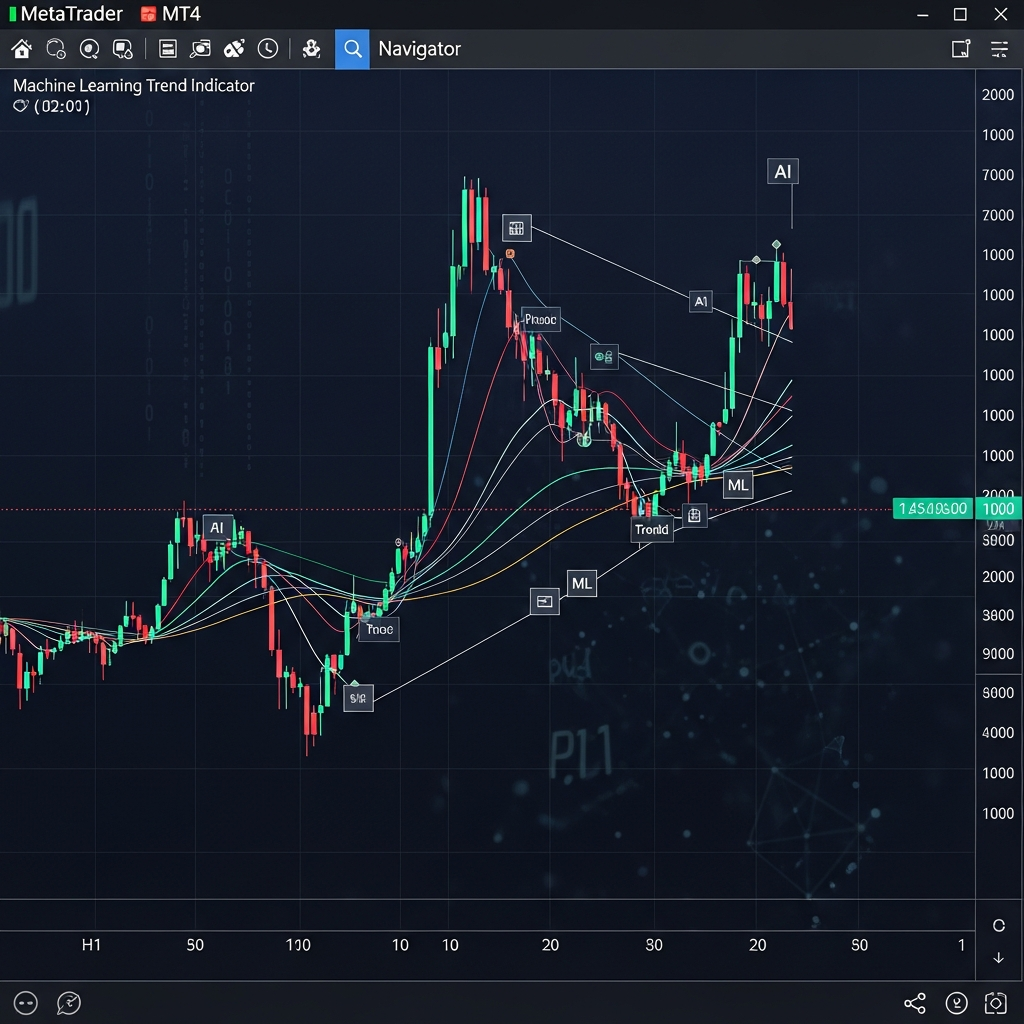
The Evolution of Trend Detection in the 2026 Forex Landscape
For decades, traders relied on the same collection of mathematical formulas: the Moving Average, the Relative Strength Index (RSI), and the MACD. While these tools served the industry well during the era of manual chart analysis, the markets of 2026 are a different beast entirely. Today, high-frequency trading (HFT) and institutional algorithms dictate price action with surgical precision. To compete, retail traders have moved beyond static indicators toward dynamic, self-evolving systems. The machine learning trend indicator for MT4 has become the cornerstone of this modern strategy.
MetaTrader 4 (MT4), despite being an aging platform, remains the most popular choice for retail traders due to its massive library of custom scripts and its accessibility. However, the standard indicators built into MT4 are inherently lagging—they tell you what happened, not what is likely to happen next. Machine learning (ML) flips this script by analyzing historical patterns to predict the probability of future price direction. By integrating ML into MT4, traders can now access institutional-grade insights from their home setups.
Understanding the Core of Machine Learning on MT4
What exactly defines a machine learning trend indicator? Unlike a standard Moving Average, which simply calculates the mean price over X periods, an ML indicator uses algorithms like K-Nearest Neighbors (KNN), Random Forest, or Support Vector Machines (SVM) to classify market states.
The K-Nearest Neighbors (KNN) Approach
In 2026, the most popular implementation for MT4 is the KNN algorithm. It is lightweight enough to run without crashing the terminal but powerful enough to offer significant predictive value. The indicator looks at the current market “features”—perhaps a combination of volatility, price momentum, and time of day—and searches its historical database for the ‘K’ most similar instances in the past. If, in those historical instances, the price moved up 70% of the time, the indicator outputs a ‘Buy’ signal.
Neural Networks and Pattern Recognition
Advanced MT4 indicators now utilize simplified neural networks. These tools are trained to recognize “signatures” of trend exhaustion or trend continuation that the human eye might miss. Instead of looking for a simple crossover, the neural network analyzes the curvature of price action and the distribution of volume to determine if a trend has institutional backing or is merely a retail-driven retracement.
Why Traditional Indicators are Failing in 2026
If you have spent any time trading in the current year, you’ve likely noticed that standard signals are producing more “fakeouts” than ever. This is because traditional indicators are linear and static. They do not adapt to changing market conditions. A 14-period RSI works beautifully in a ranging market but becomes a liability during a strong trending breakout.
A machine learning trend indicator is non-linear. It understands that a 70 RSI level means something completely different in a high-volatility environment than it does in a low-volatility one. By processing multiple data points simultaneously, ML indicators filter out the noise that usually triggers false entries. They are designed to adapt to the “regime” of the market—switching their logic when the market moves from a quiet Asian session into a volatile London-New York overlap.
Key Features of a High-Performance ML Indicator
When searching for or developing a machine learning tool for MetaTrader 4, several features distinguish a professional-grade tool from a basic script:
- Feature Selection: The ability to choose which inputs the model uses (e.g., ATR, RSI, or Price Change).
- Hyper-parameter Optimization: Tools that allow you to tune the “sensitivity” of the algorithm to avoid overfitting.
- Real-time Learning: Indicators that update their database as new bars close, ensuring the model doesn’t become obsolete as weeks pass.
- Backtesting Integrity: A reliable ML indicator must show consistent results across different currency pairs and timeframes without “cheating” by looking ahead at future data.
How to Integrate ML Indicators into Your Trading Strategy
Successfully using a machine learning trend indicator for MT4 isn’t about blindly following arrows. It requires a structured approach to risk management and confluence. In 2026, the most successful traders use a “Centaur” approach—combining human intuition with machine-generated data.
Step 1: Define the Market Regime
Before looking at the ML signal, determine if the market is in a structural trend or a range. Use the ML indicator to confirm the momentum within that structure. If the machine suggests a ‘Buy’ but the price is hitting a major daily resistance level, a prudent trader waits for a breakout and retest before committing.
Step 2: Confluence Filtering
Don’t let the ML indicator stand alone. Use it alongside price action fundamentals like support and demand zones. When an ML algorithm identifies a high-probability bullish reversal exactly at a long-term demand zone, the win rate increases exponentially.
Step 3: Dynamic Exit Strategies
One of the greatest benefits of ML is its ability to detect when a trend is losing steam before a price reversal actually occurs. Many 2026-era MT4 indicators include a “probability score.” When that score drops from 85% to 55%, it’s often a signal to tighten stop losses or take partial profits, even if the trend line hasn’t been broken yet.
The Technical Challenge: Bridging Python and MQL4
One reason machine learning took so long to become mainstream on MT4 is the limitation of the MQL4 language. MQL4 is excellent for basic arithmetic but lacks the robust libraries found in Python, such as Scikit-learn or TensorFlow. To solve this, 2026’s top-tier indicators often use a DLL (Dynamic Link Library) to bridge MT4 with an external Python environment or a pre-trained C++ model.
This setup allows the indicator to perform heavy mathematical lifting in milliseconds without freezing the MT4 interface. If you are downloading a machine learning indicator, ensure it is optimized for performance; otherwise, the latency in signal generation could cost you pips in a fast-moving market.
Overfitting: The Silent Killer of AI Trading
The biggest risk with any machine learning trend indicator is “overfitting.” This happens when an algorithm is trained too perfectly on historical data. It learns the “noise” of the past rather than the actual “signal.” On a backtest, an overfitted indicator looks like a holy grail with a 99% win rate, but it fails miserably when exposed to live, unseen market data.
To combat this in 2026, developers use techniques like cross-validation and forward-testing. As a user, you should always look for indicators that have been tested on “Out-of-Sample” data. If the indicator allows you to adjust the ‘Lookback Period,’ avoid making it too short, as this often leads the model to chase recent anomalies rather than established market behaviors.
The Future of MT4 and AI: What’s Next?
While MetaTrader 5 offers more native support for complex data structures, the community’s commitment to MT4 has forced innovation within the older platform. We are now seeing the rise of “Ensemble” indicators—tools that run three or four different machine learning models simultaneously and only issue a signal when they all reach a consensus. This “Voting” system is remarkably effective at reducing drawdowns.
Furthermore, the integration of sentiment analysis is the next frontier. Imagine a trend indicator that doesn’t just look at price, but also pulls real-time data from financial news feeds and social sentiment, processing it through a Natural Language Processing (NLP) model to gauge if a trend is fundamentally supported.
Practical Tips for 2026 Traders
- Choose Your Timeframes Wisely: ML indicators generally perform better on higher timeframes (H1, H4, Daily) where there is less noise for the algorithm to process.
- Verify the Source: With the hype around AI in 2026, many “scammy” developers are labeling standard indicators as “AI-powered.” Check for transparency in how the model is trained.
- Don’t Forget Psychology: Even with the best machine learning trend indicator for MT4, the trader must have the discipline to follow the plan and manage risk. The machine provides the edge; you provide the execution.
Conclusion
The era of guessing based on a lagging MACD crossover is over. As we move through 2026, machine learning trend indicators have transitioned from a luxury for quant funds to a necessity for the retail trader. These tools offer a way to parse through the immense complexity of modern markets, providing clear, statistically-backed signals that adapt as the world changes.
By understanding the logic behind algorithms like KNN and being mindful of the pitfalls of overfitting, you can transform your MetaTrader 4 terminal into a powerful predictive engine. The trend is your friend, but in 2026, the machine is your most reliable guide to finding it.