
Python for Forex Trading 2026: The Ultimate Tutorial for Algorithmic Success
Introduction: The Landscape of Forex Trading in 2026
As we navigate through 2026, the intersection of finance and technology has reached an unprecedented level of sophistication. The days of simple moving average crossovers are long gone, replaced by high-frequency execution and deep learning models. For the retail and institutional trader alike, Python remains the undisputed champion of the algorithmic trading world. In this 2026 guide, we will explore why Python’s evolution—specifically with the maturity of no-GIL (Global Interpreter Lock) versions—has revolutionized how we build forex bots.
Forex trading in 2026 is no longer just about reading charts; it is about processing petabytes of global sentiment, economic indicators, and order flow data in real-time. This tutorial will walk you through setting up a professional-grade trading environment, developing advanced strategies, and deploying them with the reliability required for the modern market.
Why Python is the Gold Standard for Forex in 2026
Python 3.13 and 3.14 have introduced performance enhancements that were once thought impossible for an interpreted language. With the official removal of the GIL in 2026, Python can now leverage true multi-core processing, making it competitive with C++ for many high-frequency trading tasks.
- Speed: Libraries like Polars have largely superseded Pandas for data manipulation, offering lightning-fast execution on large datasets.
- AI Integration: With the 2026 versions of PyTorch and TensorFlow, integrating Large Language Models (LLMs) for news sentiment analysis into your trading logic is now a standard practice.
- Ecosystem: The breadth of specialized libraries for technical analysis (TA-Lib), backtesting (VectorBT PRO), and brokerage connectivity (OANDA, Interactive Brokers) is unmatched.
Setting Up Your 2026 Trading Environment
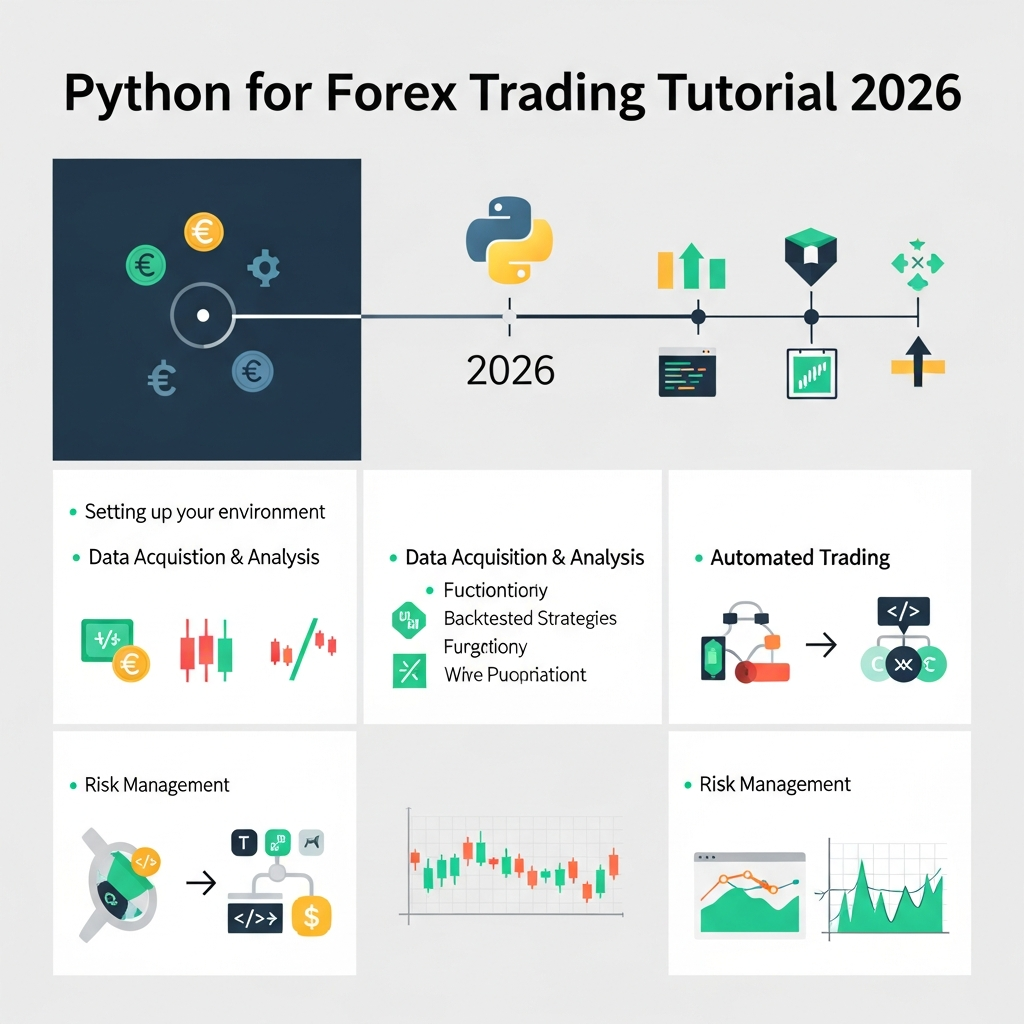
To begin your journey into Python for forex trading in 2026, you need a robust development environment. We recommend using Rye or UV for package management, as they have become the industry standard for speed and reproducibility over older tools like Pipenv or Conda.
1. Core Libraries
Your pyproject.toml should include the following essential libraries:
- Polars: For high-performance data processing.
- Numpy 2.1+: Optimized for the latest CPU architectures.
- Scikit-Learn & XGBoost: For traditional ML predictive modeling.
- QuantConnect/Lean: For local and cloud-based backtesting.
- FastAPI: To create a dashboard for monitoring your bots.
2. API Connectivity
Most traders in 2026 utilize REST and WebSocket APIs provided by brokers like OANDA or IG. WebSockets are crucial for 2026 forex trading because they provide the low-latency price streams necessary to compete in volatile sessions.
Data Acquisition and Preprocessing
In 2026, data is more than just OHLCV (Open, High, Low, Close, Volume). High-performing bots now integrate Alternative Data. This includes social media sentiment, central bank speech analysis via NLP, and even satellite data for physical commodity movement that influences currency pairs like the AUD or CAD.
Using Polars for 2026 Data Loads
Efficiency is key. Here is how we handle multi-year forex data using the latest Polars syntax:
import polars as pl

def load_data(file_path):
    return pl.scan_csv(file_path).with_columns([
        pl.col("timestamp").str.to_datetime(),
        (pl.col("close") - pl.col("open")).alias("body_size")
    ]).collect()
This lazy evaluation method ensures that even if you are analyzing 1-minute data across a decade, your system memory remains optimized.
Developing Your 2026 Forex Strategy
Static strategies are obsolete. The 2026 paradigm shifts toward Regime-Switching Models. These models use unsupervised learning to identify the current market state (Trending, Ranging, Volatile) and adjust the entry/exit parameters accordingly.
Machine Learning Integration
Using a Random Forest or a Transformer-based model, you can predict the probability of a price move. In 2026, we focus on “Feature Engineering 2.0,” where we use Fourier Transforms and Wavelet Analysis to denoise price signals before feeding them into our neural networks.
The Role of LLMs in Forex
A major breakthrough in 2026 is the local deployment of small, quantized LLMs (like Llama 4-8B) to analyze the Federal Reserve’s “Beige Book” or ECB press conferences in milliseconds. This allows your bot to trade the “narrative” before it is fully reflected in the price action.
Backtesting: The VectorBT PRO Revolution
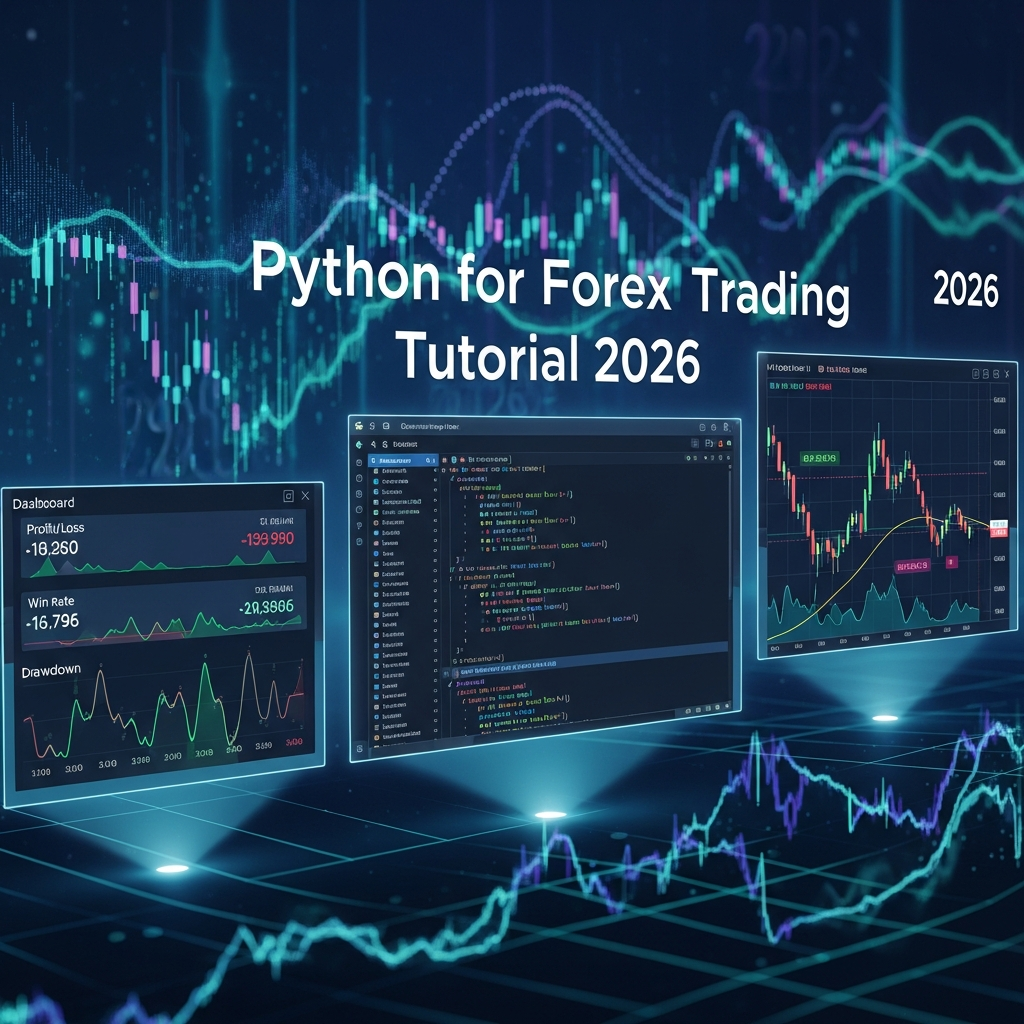
Backtesting in 2026 has moved away from slow, loop-based simulations. VectorBT PRO allows for vectorized backtesting, simulating millions of trades across thousands of parameter combinations in seconds. This allows for rigorous optimization and the discovery of “robustness islands”—parameter sets that remain profitable even under market stress.
Walk-Forward Optimization
To avoid overfitting (a common pitfall), always use Walk-Forward Optimization. This method trains the model on a specific segment of time, validates it on the next, and moves forward. It mimics how a bot learns as time progresses in a live environment.
Risk Management and Execution
In 2026, risk management is automated through Dynamic Position Sizing. Instead of risking a flat 1% per trade, modern Python scripts calculate the Kelly Criterion or Volatility-Adjusted risk. If the ATR (Average True Range) increases, the position size automatically decreases to maintain a constant dollar-at-risk profile.
Live Deployment on the Cloud
Most traders deploy their Python bots on Docker containers using AWS Lambda or Google Cloud Functions for event-driven execution. This ensures 99.9% uptime and low-latency execution by placing your bot in a data center close to the broker’s matching engine (e.g., London LD4 or New York NY4).
Advanced 2026 Logic: Reinforcement Learning
Deep Reinforcement Learning (DRL) has matured significantly by 2026. Rather than following a set of rules, a DRL agent learns the optimal policy by interacting with a simulated environment. Using the Stable-Baselines3 library, you can train an agent to maximize its reward (Sharpe Ratio) while minimizing drawdown.
from stable_baselines3 import PPO
# Pseudo-code for a 2026 RL Agent
model = PPO("MlpPolicy", env, verbose=1, device="cuda")
model.learn(total_timesteps=1_000_000)
Security and Compliance in 2026
The regulatory landscape in 2026 requires algorithmic traders to implement strict “Kill Switches.” Your Python code must include sanity checks to stop all trading if the loss exceeds a daily threshold or if the API connection becomes unstable. Additionally, with the rise of AI-driven trading, ensure your models are “explainable” (XAI) to meet the new transparency standards set by global financial authorities.
Conclusion: The Future is Pythonic
Python for forex trading in 2026 is a blend of data science, high-performance computing, and financial acumen. By leveraging the latest speed enhancements in Python 3.14, the power of Polars, and the intelligence of local LLMs, you can build a trading system that is both resilient and highly profitable.
Success in this field requires continuous learning. The markets of 2026 are faster and smarter than ever, but with the right Python toolkit, you have everything you need to stay ahead of the curve. Start small, backtest rigorously, and always prioritize risk management. Happy coding, and may your algorithms always be in the green.