Neural Network Forex Indicators for MT4: The Definitive Guide to AI Trading in 2026
The Evolution of Trading: From Lagging Indicators to Predictive Intelligence
For decades, the retail forex market was dominated by lagging indicators. Traders relied on moving averages, the Relative Strength Index (RSI), and Stochastic oscillators—tools that essentially tell you what has already happened. While these tools still hold value, the market dynamics of 2026 demand something more sophisticated. The rise of high-frequency trading (HFT) and institutional AI has made price action more complex, rendering many traditional ‘cookie-cutter’ strategies obsolete.
Enter the neural network forex indicator for MT4. Unlike a standard indicator that follows a fixed mathematical formula, a neural network is designed to learn from historical data, identify non-linear patterns, and adapt to changing market conditions. This guide explores how these AI-driven tools work, why they are essential for the modern trader, and how you can implement them within the MetaTrader 4 ecosystem.
What Exactly is a Neural Network in the Context of Forex?
At its core, a neural network is a computational model inspired by the human brain. It consists of layers of ‘neurons’ (nodes) that process information. In forex trading, these inputs are usually price data, volume, economic calendar events, or even sentiment analysis. Through a process called ‘training,’ the network assigns weights to these inputs to determine which factors are most likely to lead to a specific price movement.
In 2026, we have moved beyond simple perceptrons. Modern MT4 neural indicators often utilize Deep Learning and Recurrent Neural Networks (RNNs), specifically Long Short-Term Memory (LSTM) architectures. These are particularly effective for forex because they have ‘memory,’ allowing them to understand that a price movement five minutes ago might be relevant to a breakout happening right now.
Why MT4 Remains the Choice for AI Integration in 2026
Despite the release of MetaTrader 5 and various web-based proprietary platforms, MT4 remains the ‘gold standard’ for the retail algorithmic community. The reason is simple: the sheer volume of custom code and the robustness of the MQL4 language. However, MT4 was never natively built to handle heavy machine learning computations.
The breakthrough for neural network indicators on MT4 came through the use of DLL (Dynamic Link Library) imports. By offloading the heavy mathematical lifting to external environments like Python (using TensorFlow or PyTorch) and then piping the predictions back into the MT4 terminal, traders can have the best of both worlds: the familiar interface of MT4 and the raw power of cutting-edge AI.
How Neural Indicators Outperform Traditional Tools
Traditional indicators are linear. For example, a 50-period Moving Average calculates the mean price and plots it. It doesn’t care if the market is currently in a low-volatility ‘squeeze’ or a high-volatility news event. It simply calculates the average.
A neural network indicator, however, looks for confluence and context. It might recognize that when the RSI is overbought *and* the market is approaching a specific Fibonacci level *and* the volatility is increasing, a reversal is 85% likely based on the last three years of data. It identifies the hidden correlations that are invisible to the naked eye.
Key Features of an Effective Neural Network Indicator
Not all AI indicators are created equal. As you navigate the marketplace in 2026, look for these specific features to ensure you are using a tool that provides a genuine edge:
- Self-Learning Capabilities: The indicator should allow for periodic ‘re-training.’ Markets evolve; a model that worked in the low-interest-rate environment of 2026 might struggle in the volatile landscapes of today.
- Walk-Forward Optimization: This is a technique where the indicator is tested on a ‘blind’ segment of data it hasn’t seen before to ensure it hasn’t simply ‘memorized’ the past (overfitting).
- Multi-Timeframe Correlation: The best neural networks analyze data across several timeframes simultaneously to confirm that a signal on the M15 chart is supported by the H4 trend.
- Sentiment Integration: Advanced 2026 models often incorporate retail sentiment data, providing a contrarian view when the crowd is overly long or short.
The Danger of the ‘Black Box’ and Overfitting
One of the biggest hurdles for traders using neural networks is the ‘Black Box’ problem. Unlike a trendline, you cannot always see ‘why’ a neural network gave a buy signal. This can lead to a lack of confidence during a losing streak.
Furthermore, overfitting is the silent killer of AI accounts. This occurs when a neural network is trained so specifically on historical data that it recognizes every minor ‘noise’ as a pattern. In backtesting, an overfitted indicator looks like a ‘Holy Grail’ with a 99% win rate. In live trading, it fails because real-time market noise is never exactly the same as historical noise. Authoritative trading requires a balance between mathematical precision and market logic.
Practical Setup: Implementing Neural Networks in MT4
If you are looking to deploy a neural network indicator in your MT4 terminal, the process generally follows these steps:
1. Data Acquisition and Cleaning
Neural networks are only as good as the data they consume. In 2026, most professional-grade indicators require high-quality ‘Tick Data’ rather than just ‘Bar Data.’ This ensures the AI understands the intra-candle volatility.
2. Choosing the Architecture
Are you looking for a Classification model (Buy, Sell, or Neutral) or a Regression model (Predicting the actual price at a future point)? Most successful retail indicators focus on classification, as predicting exact price targets in a decentralized market like Forex is notoriously difficult.
3. The Bridge (Python to MQL4)
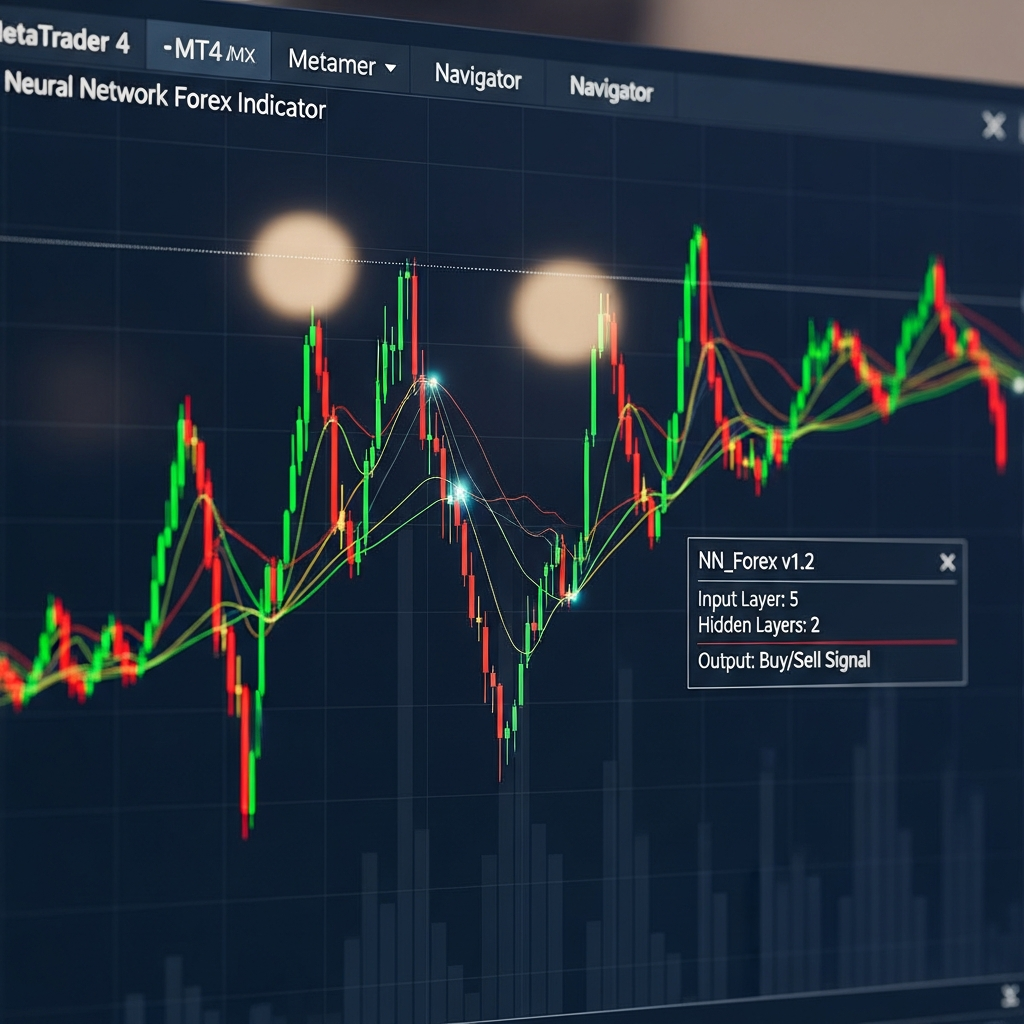
Most modern neural indicators act as a bridge. They collect the live OHLC (Open, High, Low, Close) data from your MT4 chart, send it to an external server or a local Python script for processing, and then return a visual signal (like an arrow or a heat map) back to your screen.
Risk Management in the Age of AI
Even the most advanced neural network cannot predict a ‘Black Swan’ event—a sudden geopolitical crisis or an unexpected central bank intervention. In 2026, the hallmark of a professional trader is not just using AI, but how they manage the AI’s output.
You should never risk more than 1-2% of your capital on a single AI-generated signal. Furthermore, neural indicators should be used as a Decision Support System (DSS) rather than an automated pilot. The most successful traders use AI to filter out bad trades, while still maintaining manual control over entries and exits during high-impact news events.
The Myth of the ‘No-Loss’ AI Indicator
In your search for the best MT4 neural network indicator, you will inevitably encounter marketing that promises 100% accuracy. This is a mathematical impossibility. The goal of a neural network is to shift the probability in your favor—from a 50/50 coin flip to a 60/40 or 65/35 edge. Over hundreds of trades, this edge results in a growing equity curve.
The Future: What’s Next After 2026?
As we look beyond the current year, the integration of Quantum Computing with neural networks is the next frontier. Quantum-enhanced neural networks will be able to process market correlations across hundreds of currency pairs and commodities in milliseconds—a feat currently limited by classical hardware.
For now, the focus for retail traders should be on mastering the tools available. An MT4 neural network indicator is no longer a luxury or a ‘futuristic’ toy; it is a necessary component of a competitive trading toolkit. By leveraging the power of machine learning, you can strip away the emotional biases of human trading and navigate the markets with a data-driven perspective.
Conclusion: Embracing the Machine
The transition to neural network indicators represents a paradigm shift in how we approach the Forex market. By moving away from rigid, legacy formulas and toward adaptive, learning systems, traders can finally keep pace with the institutional giants. While the learning curve can be steep—and the risk of over-optimization is real—the potential rewards of a well-calibrated AI strategy are unmatched.
Whether you are a scalper looking for micro-trends or a swing trader seeking long-term reversals, there is a neural network configuration that can enhance your edge. The key is to remain disciplined, prioritize risk management, and treat your AI indicator as a sophisticated partner in the quest for market profitability.