
Migrating Your Trading Edge: The Definitive Guide to MT4 to MT5 Indicator Converter Tools in 2026
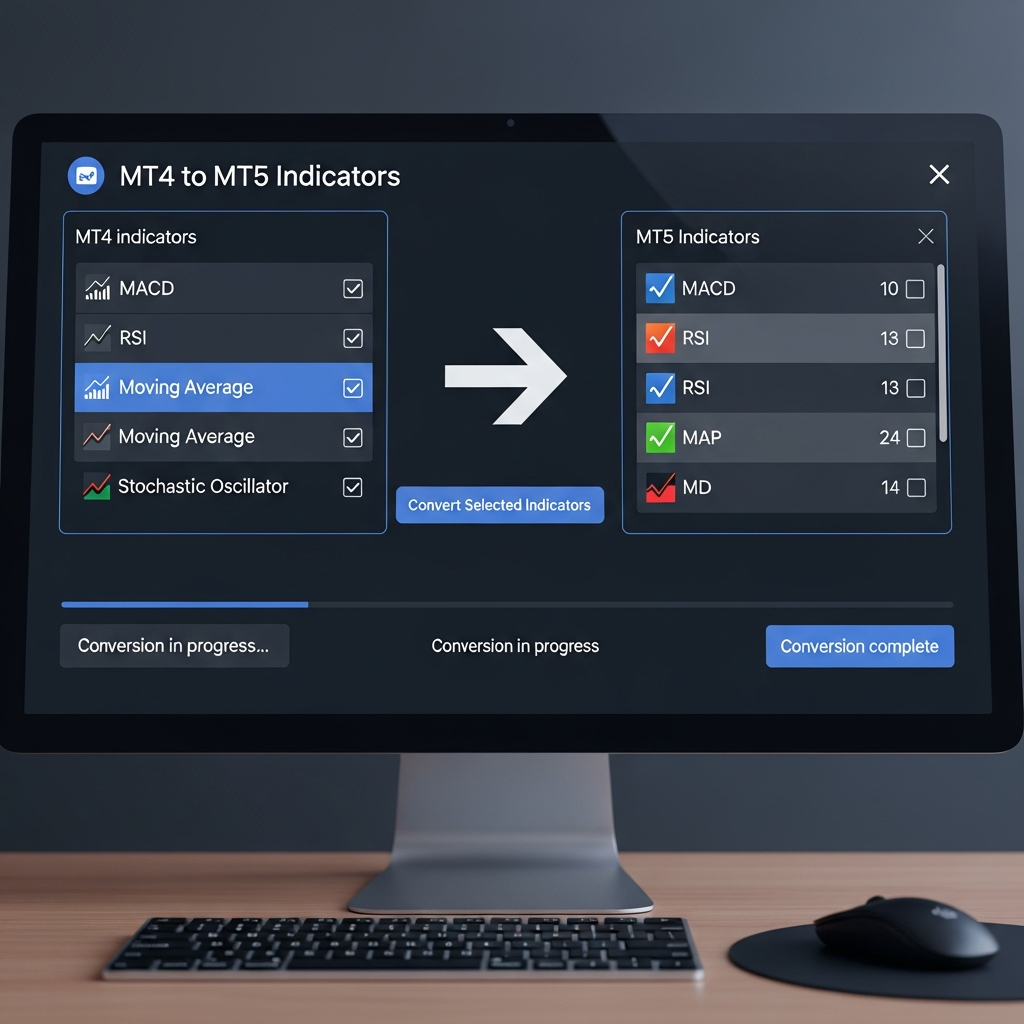
The Great Migration: Why MT4 to MT5 Indicator Conversion is Essential in 2026
For nearly two decades, MetaTrader 4 (MT4) was the undisputed king of retail forex trading. However, as we move through 2026, the industry landscape has shifted decisively. Brokerages have largely transitioned to MetaTrader 5 (MT5) to leverage its superior multi-asset capabilities, faster execution speeds, and 64-bit architecture. Despite this, many veteran traders remain tethered to MT4 for one reason: their library of custom indicators.
If you have spent years perfecting a proprietary technical analysis tool in MQL4, the prospect of losing that edge is daunting. This has led to a massive surge in demand for the MT4 to MT5 indicator converter tool. Whether you are using an automated script, a cloud-based AI converter, or a manual rewriting service, understanding how to bridge the gap between these two distinct languages is critical for modern trading success.
The Technical Divide: Why a Simple Copy-Paste Fails
To understand why you need a specialized converter tool, you must first understand the fundamental differences between MQL4 and MQL5. While they look similar on the surface, their underlying logic is vastly different.
Procedural vs. Object-Oriented Programming
MQL4 was originally a procedural language. It was designed for simplicity, making it easy for non-programmers to write basic scripts. MQL5, however, is a fully functional object-oriented programming (OOP) language based on C++. This means that while MQL4 handles data linearly, MQL5 organizes data and functions into ‘objects,’ allowing for much more complex and efficient code—but at the cost of a steeper learning curve.
Event Handling Differences
In the old MT4 environment, indicators primarily relied on the start() function to execute code on every price tick. In the MT5 environment of 2026, we use specialized event handlers like OnCalculate(), OnInit(), and OnTimer(). A converter tool must not only change the names of these functions but also restructure how the indicator listens to the market data.
Types of MT4 to MT5 Indicator Converter Tools in 2026
As of 2026, the technology for migrating code has evolved beyond simple regex find-and-replace scripts. Here are the three primary methods traders use today:
1. AI-Driven LLM Converters
The most significant breakthrough in recent years is the integration of Large Language Models (LLMs) specifically trained on the MQL syntax documentation. Modern converter tools now use AI to ‘read’ the logic of your MT4 indicator and rewrite it from scratch in MQL5. Unlike older tools, these AI converters understand context, meaning they can handle complex array sizing and indicator buffer mapping that used to break automated scripts.
2. The MQL4-to-MQL5 Wrapper Libraries
Some developers have created ‘bridge’ or ‘wrapper’ files (header files with .mqh extensions). By including these files in your MT5 project, you can use legacy MQL4 commands that the wrapper then ‘translates’ into MQL5 commands in real-time. While this is the fastest way to get an indicator running, it is often less efficient than a clean rewrite and can lead to lag on high-frequency charts.
3. Standalone Software Converters
There are several desktop applications designed to batch-convert .mq4 files into .mq5 files. These are ideal for traders who have hundreds of indicators and need a bulk solution. These tools typically scan the source code for deprecated functions (like iCustom or iBarShift) and replace them with the modern MQL5 equivalents.
Step-by-Step Guide: Using a Modern Converter Tool
If you have downloaded an MT4 to MT5 converter tool, the process usually follows a specific workflow. Following these steps ensures the highest chance of a successful compilation.
Step 1: Source Code Preparation
Ensure you have the .mq4 file (source code) rather than just the .ex4 file (compiled executable). No converter tool can reliably decompile an .ex4 file into working MQL5 code due to encryption and security protocols updated in 2026.
Step 2: Buffer Mapping
In MT4, indicators were limited in how many ‘buffers’ (data streams) they could display. MT5 has virtually no limit. When using a converter, you must define which MQL4 arrays correspond to the new MQL5 indicator buffers. Most premium tools in 2026 offer a visual interface for this mapping.
Step 3: Handling Series Arrays
A common pitfall is the direction of price data. In MT4, the most recent candle is usually index 0. In MT5, the behavior can be toggled using ArraySetAsSeries(). A quality converter will automatically insert the correct series flagging to ensure your indicator doesn’t display ‘backward’ data.
Step 4: Compilation and Debugging
Once the tool generates an .mq5 file, open it in the MetaEditor 5. Hit ‘Compile.’ If errors appear, they are usually related to specific technical indicators that require ‘handles’ in MQL5 (like moving averages or RSI). In MT5, you must create a handle for an indicator in OnInit() before you can pull data from it in OnCalculate().
The Benefits of Moving to MT5 Indicators
While the conversion process can be technical, the rewards for migrating your tools in 2026 are substantial:
- Multi-Threaded Backtesting: You can test your converted indicators across multiple currency pairs simultaneously in the MT5 Strategy Tester, a feat impossible in MT4.
- Lower Latency: MQL5 is executed significantly faster, which is vital for scalping indicators and real-time volatility alerts.
- Cloud Integration: MT5 allows for easier integration with external Python libraries and cloud databases, enabling you to enhance your old indicators with machine learning inputs.
Common Pitfalls to Avoid
Even the best MT4 to MT5 indicator converter tool isn’t magic. Here is what to watch out for:
Object Redrawing Issues
If your MT4 indicator draws objects on the chart (like arrows, rectangles, or text), the coordinate system in MT5 is different. MQL5 uses ObjectCreate with different parameters. Check if your converter handles the transition from datetime and price coordinates correctly.
Data Access Latency
MQL5 is asynchronous. This means sometimes the indicator tries to calculate values before the price history has fully downloaded from the server. Your converted code must include checks like SeriesInfoInteger to ensure the data is ready.
Security of Online Converters
Be wary of ‘free’ online conversion websites. In 2026, intellectual property theft is common. When you upload your proprietary MQL4 source code to a random website, you are essentially handing over your trading strategy. Always use local software or reputable AI services with strict privacy policies.
Is Manual Rewriting Better?
While automated tools are excellent for 80% of the work, the final 20% often requires a human touch. For high-stakes institutional indicators, many traders use a converter tool to build the ‘skeleton’ of the MQL5 code and then hire a professional MQL5 developer to optimize the logic. This hybrid approach is the gold standard in 2026, combining the speed of automation with the reliability of expert coding.
Conclusion: Future-Proof Your Trading
The transition from MT4 to MT5 is no longer a choice—it is a requirement for anyone serious about the financial markets. By utilizing a high-quality MT4 to MT5 indicator converter tool, you can preserve the years of research and testing embedded in your custom indicators while gaining the performance advantages of the MetaTrader 5 platform.
As we look toward the remainder of 2026, the gap between these platforms will only widen. Start migrating your library today to ensure that when MT4 eventually reaches its final sunset, your trading edge remains sharper than ever.