
Navigating the Markets: The Evolution of Candlestick Pattern Recognition on MetaTrader 4

The Persistence of Visual Data in Modern Trading
In the high-speed world of financial markets, the visual representation of price data remains the cornerstone of technical analysis. Since the 18th century, when Munehisa Homma revolutionized rice trading in Japan, candlestick charts have provided a unique window into the collective psychology of buyers and sellers. Today, despite the rise of complex quantitative algorithms, the core essence of price action remains unchanged. However, for the modern trader operating in 2026, the challenge isn’t just understanding what a ‘Morning Star’ or an ‘Engulfing’ pattern means; it is the physical and mental exhaustion of scanning dozens of assets across multiple timeframes to find them.
This is where candlestick pattern recognition software for MetaTrader 4 (MT4) bridges the gap between traditional wisdom and modern efficiency. MT4 remains a powerhouse in the retail trading space because of its flexibility and the vast ecosystem of custom tools developed over decades. By automating the identification process, traders can move away from the screen-staring fatigue and focus on what truly matters: risk management and execution.
The Psychology Behind the Patterns
Before diving into the technicalities of the software, it is vital to understand why we seek these patterns in the first place. A candlestick isn’t just a rectangle with wicks; it is a battle report. The body represents the distance between the open and the close, while the wicks show the extremes of emotion—fear and greed—during that specific period.
When a pattern like a ‘Pin Bar’ or ‘Hammer’ forms at a key support level, it signals a rejection of lower prices. When software identifies this instantly, it removes the subjective bias of the human eye. We often see what we want to see. If we are bullish on the Euro, our brains might ‘invent’ a bullish engulfing pattern where there isn’t one. Software, however, is binary. It follows strict mathematical parameters, ensuring that the pattern either meets the criteria or it does not.
How Candlestick Recognition Software Works on MT4
MT4 software designed for pattern recognition typically operates as a custom indicator (.ex4 or .mq4 file). These tools are coded to analyze the relationship between the Open, High, Low, and Close (OHLC) data of a specific sequence of candles.
For instance, a standard Bullish Engulfing recognition script looks for a two-candle sequence where the second candle is bullish and its body completely encompasses the body of the previous bearish candle. In the past, these scripts were relatively primitive. However, in 2026, many of these indicators have evolved. They now incorporate ATR (Average True Range) filters to ensure the pattern has enough ‘size’ to be significant, or they use volatility filters to ignore patterns that form during low-liquidity periods like the Asian session doldrums.
Key Features of Premium Recognition Tools
- Multi-Pattern Detection: The ability to toggle between dozens of patterns, from simple Dojis to complex Three Inside Up formations.
- Real-Time Alerts: Perhaps the most critical feature. The software can send push notifications to your mobile device, emails, or pop-up alerts the moment a candle closes and confirms a pattern.
- Historical Backtesting: Modern MT4 tools allow you to see how often a specific pattern has resulted in a profitable move on a specific pair over the last year.
- Customizable Parameters: Not all ‘Hammers’ are equal. Premium software allows you to define the ratio of the wick to the body, ensuring only the highest quality signals are highlighted.
The Efficiency Gap: Manual vs. Automated Scanning
The average retail trader might track 5 to 10 currency pairs. If they are trading the 15-minute chart, that is 40 potential patterns to check every hour across all pairs. The margin for error is massive. Fatigue leads to missing the ‘perfect’ setup and then ‘revenge trading’ on a sub-par setup to make up for it.
Automated recognition software eliminates this ‘efficiency gap.’ By the time we reach mid-2026, the integration of light machine learning within MT4 indicators has become more common. These tools don’t just find the pattern; they score it based on the surrounding market structure. They identify if the pattern is ‘with the trend’ or ‘counter-trend,’ significantly increasing the probability of success.
Integrating Recognition Software into a Trading Strategy
It is a common mistake for novice traders to treat candlestick recognition software as a ‘buy/sell’ signal generator in a vacuum. A Doji on its own is meaningless. A Doji at a 61.8% Fibonacci retracement level on a daily chart is a high-probability reversal signal. To use this software effectively on MT4, one must combine it with other confluence factors.
The Confluence Model
A robust strategy might look like this:
- Identify Trend: Use a 200-period Moving Average to determine the long-term bias.
- Locate Value: Wait for price to pull back to a horizontal support/resistance zone or a psychological round number.
- Pattern Confirmation: Use the MT4 recognition software to identify a reversal candle (like a Piercing Line or Shooting Star) at that specific zone.
- Execution: Enter the trade with a stop-loss placed just beyond the wick of the identified pattern.
The Evolution of MT4 Tools in 2026
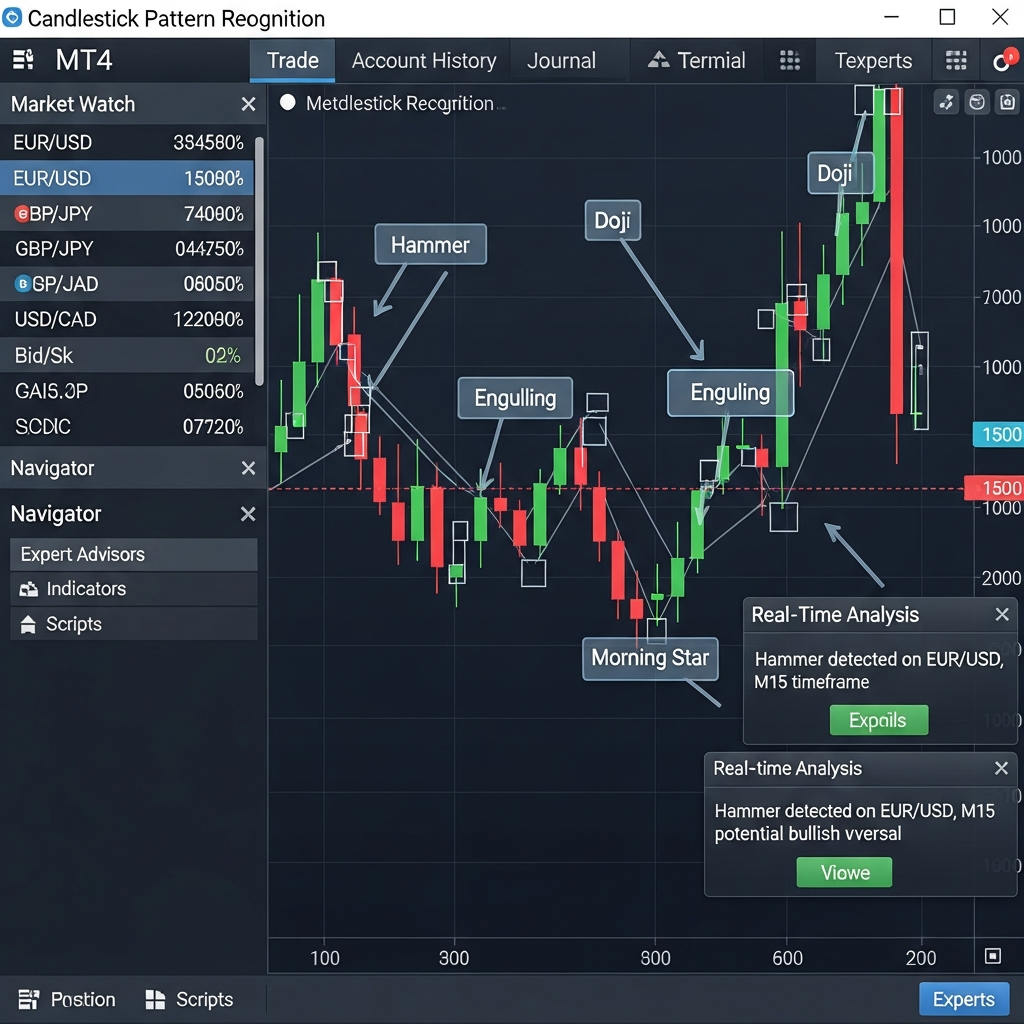
While MetaTrader 5 (MT5) has seen increased adoption, MT4 remains the ‘old reliable’ for many traders due to the sheer volume of legacy code and custom-built indicators. In 2026, the developers in the MQL4 community have pushed the envelope of what the platform can handle. We now see ‘Dashboard’ indicators that scan the entire market watch list and display a grid of which patterns are forming on every timeframe from M1 to MN.
This ‘Bird’s Eye View’ allows a trader to see, for example, that the GBP/USD is showing a bearish engulfing on the H4 chart while simultaneously showing a pin bar on the D1. This kind of fractal analysis was once the domain of institutional desks but is now accessible to anyone with a standard MT4 setup.
Common Pitfalls and How to Avoid Them
No software is a magic bullet. When using candlestick recognition tools on MT4, there are several traps to avoid:
1. The Repainting Issue
Some lower-quality indicators ‘repaint.’ This means they might show a pattern while the candle is still moving, and then remove the signal if the price shifts before the close. Always ensure your software only triggers an alert on the closed candle. Price action is not confirmed until the period ends.
2. Pattern Overload
If you turn on every single pattern detection setting, your chart will be cluttered with icons and text. This leads to ‘analysis paralysis.’ It is often better to focus on 3 or 4 high-probability patterns (like the Pin Bar, Engulfing, and Morning/Evening Star) rather than trying to trade every Harami or Spinning Top that appears.
3. Ignoring Context
Software is blind to news events. If a massive ‘Bullish Engulfing’ pattern forms seconds before a Central Bank interest rate announcement, the software will flag it as a buy. However, a seasoned trader knows that technical patterns are often invalidated by high-impact fundamental news. Use an economic calendar alongside your recognition software.
Installation and Optimization
Setting up these tools is straightforward. Once you have acquired the indicator file:
- Open MT4 and go to File > Open Data Folder.
- Navigate to MQL4 > Indicators and paste the file.
- Restart MT4 or refresh the Indicators list in the Navigator panel.
- Drag the indicator onto your chart and allow ‘DLL imports’ if the software requires it for external alerts.
Optimization is the next step. Most traders fail because they use the default settings. In 2026, market volatility is different than it was in 2020. Adjust your indicator’s sensitivity to match the current ‘new normal’ of the pair you are trading. High-volatility pairs like Gold (XAU/USD) require wider parameters for pattern recognition than stable pairs like EUR/CHF.
Conclusion: The Future of Price Action
Candlestick pattern recognition software for MT4 is not about replacing the trader’s intuition; it is about amplifying it. By removing the drudgery of manual scanning, these tools allow traders to operate with the precision of a machine and the judgment of a human.
As we move further into 2026, the line between manual and algorithmic trading continues to blur. Whether you are a swing trader looking for daily reversals or a scalper hunting for M5 momentum shifts, automating your pattern recognition is a logical step in the professionalization of your trading desk. The markets are hard enough to navigate; there is no reason to do it without the best navigational aids available.
Final Thoughts for the Modern Trader
If you are looking to integrate these tools, start by testing them on a demo account. Observe how the software handles different market conditions—trending, ranging, and breakout phases. Remember that the best software is the one that fits your specific psychological profile. If you are naturally conservative, look for recognition tools that offer ‘Strict’ mode, filtering out anything but the most textbook-perfect patterns. The goal is consistency, and in the world of MT4 trading, consistency is built on a foundation of repeatable, objective analysis.