
Trading Against the Herd: A Professional Guide to MT4 Sentiment Indicators
Understanding the Third Pillar of Market Analysis
For decades, the retail trading world has been divided into two primary camps: technical analysis and fundamental analysis. Technical traders spend their hours staring at candlesticks, Fibonacci retracements, and oscillators like the RSI. Fundamental traders, on the other hand, are glued to economic calendars, central bank speeches, and geopolitical shifts. However, as we move through 2026, a third pillar has become indispensable for anyone serious about the MetaTrader 4 (MT4) platform: Sentiment Analysis.
Sentiment analysis is the study of the collective mood of market participants. It doesn’t look at where the price should go based on a mathematical formula, nor does it look at where it should go based on an interest rate hike. Instead, it looks at where traders are actually putting their money. It asks a simple but profound question: Is the crowd currently bullish or bearish? In the high-velocity markets of today, being able to visualize this data through a sentiment analysis indicator for MT4 is often the difference between getting trapped in a false breakout and riding a genuine trend.
Why You Need a Sentiment Indicator for MT4
MetaTrader 4 remains the world’s most popular retail trading platform, even in 2026. Its longevity is due to its massive library of custom indicators. However, by default, MT4 is a price-lagging environment. Standard indicators like Moving Averages or Bollinger Bands tell you what has already happened. They are reactive.
A sentiment indicator is predictive in a unique way. It provides a window into the “retail herd.” In the Forex market, it is a well-documented phenomenon that the majority of retail traders lose money. Therefore, if you can see that 90% of retail traders are currently long on EUR/USD, a sentiment indicator provides a powerful contrarian signal. It suggests that the market may be reaching a point of exhaustion, as there are few buyers left to push the price higher, and a reversal may be imminent.
How Sentiment Indicators Actually Work
Unlike a standard RSI that calculates data based on price history stored in your terminal, a sentiment indicator for MT4 must pull data from external sources. Because the Forex market is decentralized (there is no single exchange), “sentiment” is usually aggregated from three main sources:
- Broker Data: Large brokers provide a percentage of their clients who are long versus short.
- Exchange Data: For those trading currency futures, the Commitments of Traders (COT) report provides institutional positioning.
- Social/Community Data: Platforms like Myfxbook or TradingView aggregate thousands of connected accounts to show a broader retail consensus.
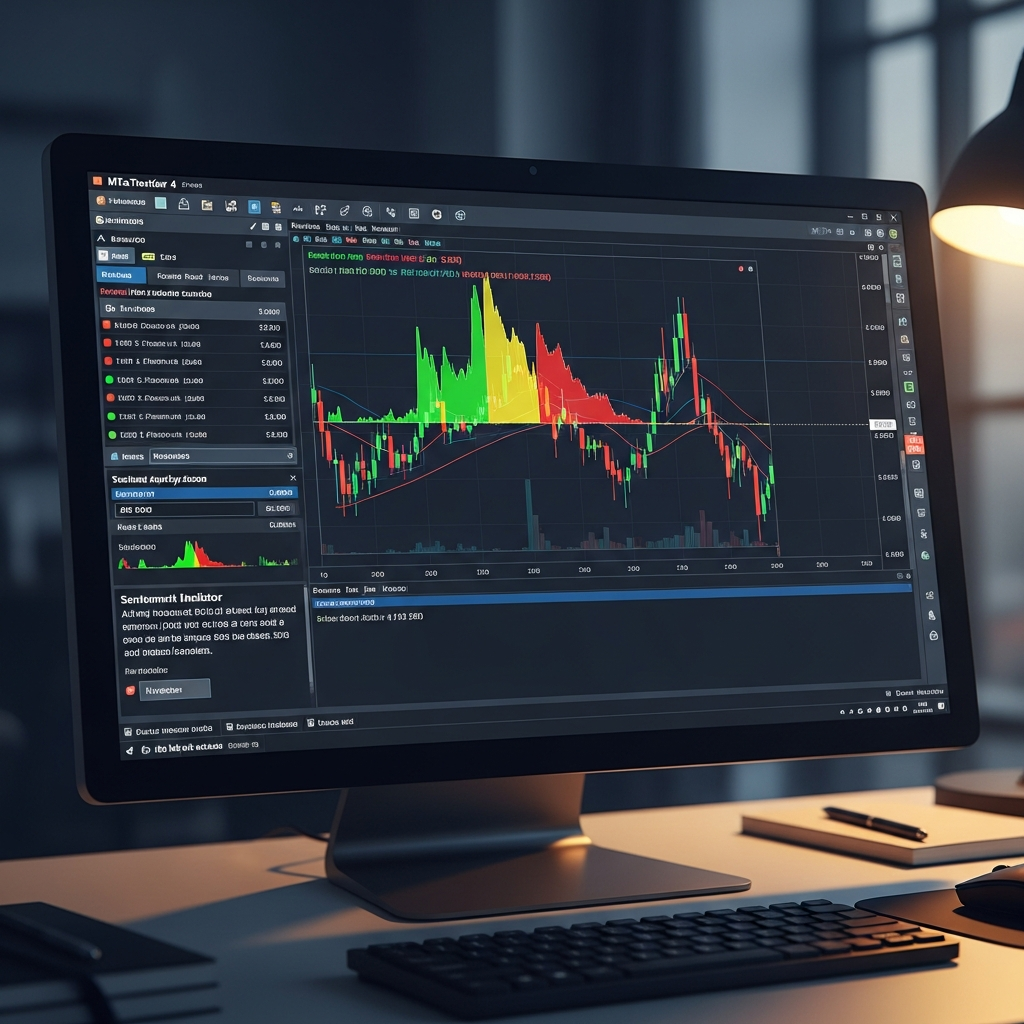
A high-quality MT4 indicator will scrape this data in real-time and plot it directly on your chart, usually as a histogram or a simple percentage gauge in the corner of the screen.
Setting Up Your MT4 Sentiment Dashboard
To use sentiment analysis effectively, you shouldn’t treat it as a standalone signal. Instead, it should function as a filter for your existing strategy. In 2026, the most successful traders use a multi-layered dashboard approach. Here is how you should configure your MT4 setup:
1. The Macro Sentiment View
This is usually a daily sentiment reading. It tells you the general bias. If the daily sentiment shows a massive imbalance—for example, 85% of traders are shorting the GBP/JPY—you should be very cautious about joining that short move. This is an “extreme sentiment” reading, which often precedes a massive short squeeze.
2. The Intraday Shift
Look for changes in sentiment over the last 4 to 8 hours. If the price is moving up, but the percentage of long traders is actually decreasing, it means the rally is being driven by institutional buying rather than retail FOMO. This is a very bullish sign.
3. Confluence with Technicals
The magic happens when sentiment meets structure. Imagine the price of Gold hits a major daily resistance level. You check your sentiment indicator for MT4 and see that retail traders have just started aggressively buying the breakout. Because you know the crowd is often wrong at turning points, this gives you the confidence to look for a short entry at that resistance level, essentially trading against the late-arriving retail buyers.
Top Strategies for Sentiment-Based Trading
The Contrarian Extremes Strategy
This is the most popular way to use sentiment. The logic is simple: when everyone is already in, there is no one left to keep the trend going. In 2026, we see this frequently during “Black Swan” events or major central bank pivots. When the sentiment indicator hits a 90/10 split, the market is overextended. Traders look for a reversal pattern (like a Pin Bar or an Engulfing Candle) to trade in the opposite direction of the 90%.
The Trend Confirmation Filter
If you are a trend follower, sentiment can help you stay in a trade longer. A healthy trend is one where the crowd is actually betting against it. If the USD/CHF is trending up, but the retail sentiment stays consistently short (e.g., 60-70% short), the trend has plenty of “fuel” to continue. The retail shorts will eventually be forced to cover their positions, which creates more buying pressure.
The Best Sentiment Data Sources for MT4 in 2026
As the technology has evolved, the quality of data has improved significantly. When looking for a sentiment indicator to download or purchase, ensure it integrates data from the following:
- IG Client Sentiment: Still one of the most reliable proxies for retail behavior due to their massive client base.
- Oanda Order Book: Provides not just long/short percentages, but also where the pending orders and stop losses are clustered.
- The Speculative Sentiment Index (SSI): A classic tool that has been updated for the 2026 market environment to include high-frequency trading (HFT) noise filters.
Common Pitfalls to Avoid
While sentiment analysis is powerful, it is not a magic bullet. The most common mistake is ignoring the timeframe. A sentiment reading might be extremely bullish on a 5-minute chart but neutral on a Daily chart. Always align your sentiment analysis with the timeframe you are actually trading.
Another pitfall is the “Early Contrarian” trap. Just because sentiment is 70% long doesn’t mean the price will drop immediately. Markets can remain irrational and overextended much longer than you can remain solvent. Use sentiment to build a thesis, but use price action to time your entry.
Advanced Integration: Sentiment and AI in 2026
We cannot discuss MT4 indicators in 2026 without mentioning the integration of Artificial Intelligence. Modern sentiment indicators now use Natural Language Processing (NLP) to scan news headlines and social media platforms like X (formerly Twitter) and Reddit in real-time. This “Social Sentiment” is then converted into a numerical value and plotted on MT4 alongside the traditional broker data. This gives traders a much more holistic view of the market’s psychological state than was possible just a few years ago.
Conclusion: Mastering the Psychology of the Market
The introduction of a sentiment analysis indicator for MT4 into your trading toolkit marks the transition from a reactive trader to a proactive one. By understanding where the crowd is positioned, you gain the ability to step back and see the market for what it truly is: a continuous transfer of wealth from those who follow the herd to those who understand the herd’s limitations.
Whether you are using it to find contrarian reversals or to confirm a long-term trend, sentiment data provides a layer of context that price alone cannot offer. In the competitive landscape of 2026, where algorithms and retail traders are constantly clashing, having a visual representation of market psychology is no longer an optional luxury—it is a fundamental requirement for success. Start small, observe how sentiment shifts during major news releases, and soon you will find yourself seeing the markets with a clarity you never thought possible.