
How Machine Learning Buy Sell Signals are Revolutionizing MetaTrader 4 in 2026
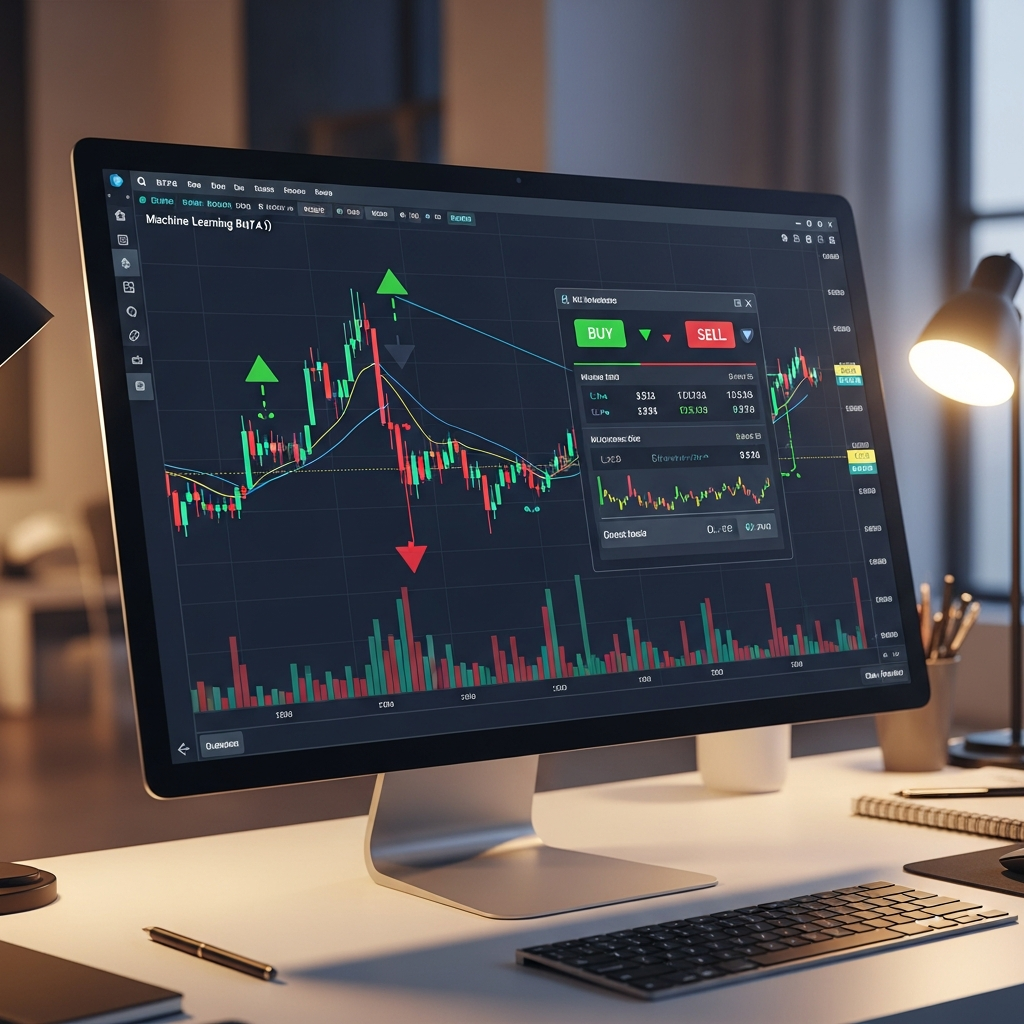
The Paradigm Shift: From Lagging Indicators to Predictive Intelligence
For over two decades, MetaTrader 4 (MT4) has remained the cornerstone of the retail trading world. Despite the rise of newer platforms, its simplicity and the vast ecosystem of Expert Advisors (EAs) have kept it relevant. However, as we navigate the financial landscapes of 2026, the methodology behind trading signals has undergone a radical transformation. The days of relying solely on the crossing of two moving averages or a simple RSI divergence are fading into the background. Today, the most sophisticated traders are leveraging machine learning (ML) buy sell signals on MT4 to gain a predictive edge in an increasingly efficient market.
The core problem with traditional technical analysis is its inherent lag. Indicators like the MACD or Bollinger Bands look at historical price action and project it forward under the assumption that history repeats itself linearly. Machine learning, however, does not look for simple repetitions; it searches for multi-dimensional patterns across vast datasets that the human eye—and traditional math—simply cannot perceive.
Understanding Machine Learning in the Context of MetaTrader 4
Machine learning is a subset of artificial intelligence that focuses on building systems that learn from and make decisions based on data. In the context of MT4, this usually involves an external processing layer. Since MQL4 (the language of MT4) is relatively limited in its native mathematical libraries compared to Python or R, 2026’s best signal generators use a bridge. This bridge allows MT4 to send real-time price data to a Python script running a trained model, which then returns a buy or sell signal back to the terminal.
Classification vs. Regression: How Signals are Generated
When we talk about machine learning signals, we are usually referring to one of two types of models:
- Classification Models: These models answer the question, “Is this a Buy, Sell, or Neutral setup?” They categorize market conditions based on features like volatility, volume, and price velocity.
- Regression Models: These models attempt to predict a specific value, such as the closing price of the next candle. A buy signal is generated if the predicted price is significantly higher than the current price.
- Reinforcement Learning: The most advanced signals in 2026 come from agents that learn through trial and error, optimizing for a reward (profit) and penalizing for a loss (drawdown).
- Sentiment Analysis: Integrating ML signals often means scanning news feeds and social media, converting qualitative data into quantitative signals that MT4 can execute.
Why Traditonal Indicators Fail Where Machine Learning Succeeds
The primary reason traders are flocking to ML-integrated signals is the reduction of “market noise.” Traditional indicators are static; an RSI of 70 is always “overbought,” whether the market is trending strongly or ranging. A machine learning model, however, can be trained to recognize that in a high-momentum bull market, an RSI of 70 is actually a sign of strength, not a signal to sell.
By using algorithms like Random Forests or Gradient Boosting (XGBoost), these signals can weigh dozens of factors simultaneously. A signal isn’t just triggered because price hit a support level; it’s triggered because price hit a support level, while volume was increasing, while the EUR/USD was showing a specific correlation to the 10-year Treasury yield, and while a neural network identified a recurring fractal pattern from the last five years of data.
Implementing ML Buy Sell Signals on MT4: A 2026 Perspective
In 2026, you no longer need a PhD in Data Science to use these tools. The “No-Code” revolution has reached MT4. There are now several reputable plugins and DLL-based indicators that allow traders to import pre-trained models directly into their charts.
1. Data Preprocessing: The Critical First Step
The quality of a buy/sell signal is only as good as the data fed into the model. Professional ML signals for MT4 use “feature engineering.” This involves taking raw OHLC (Open, High, Low, Close) data and transforming it into something more meaningful, such as the rate of change, the distance from a moving average, or Fourier transforms to identify cyclicality. In 2026, most advanced signals use automated feature selection to determine which data points are currently influencing price the most.
2. The Python-MT4 Bridge
Most high-end machine learning indicators today operate via a 0-latency bridge. The MT4 terminal acts as the execution engine and UI, while a local or cloud-based Python environment handles the heavy lifting of the Long Short-Term Memory (LSTM) networks. This allows for complex deep learning architectures that would crash a standard MT4 terminal if run natively.
3. Real-Time Model Retraining
The “holy grail” of 2026 trading is the self-adaptive signal. Traditional EAs become obsolete as market regimes change (e.g., shifting from a low-volatility environment to a high-inflation, high-volatility one). Modern ML signals use a process called Online Learning, where the model continuously updates its weights based on the most recent 1,000 candles, ensuring the buy/sell logic evolves alongside the market.
Key Algorithms Powering MT4 Signals Today
If you are looking for a machine learning signal provider or building your own, these are the architectures currently dominating the 2026 landscape:
K-Nearest Neighbors (KNN)
KNN is one of the more popular “simple” ML algorithms used in MT4. It looks at the current market state and finds the ‘K’ most similar historical instances. If, in 80% of those historical instances, the price moved up 50 pips, the indicator generates a “Buy” signal. It is intuitive and works exceptionally well for short-term scalping.
Recurrent Neural Networks (RNN) and LSTMs
These are designed for sequential data. Unlike a standard indicator that only looks at the current candle, an LSTM remembers what happened 10, 50, or 100 candles ago and understands how that sequence leads to the current moment. This makes them incredibly powerful for catching the start of new trends.
Support Vector Machines (SVM)
SVMs are excellent for classification in volatile markets. They create a multi-dimensional “hyperplane” that separates buy zones from sell zones. Traders use SVM-based signals on MT4 to filter out false breakouts, as the algorithm is adept at recognizing the difference between a genuine trend change and a liquidity grab.
The Importance of Walk-Forward Optimization
One of the biggest traps in machine learning for MT4 is “overfitting.” This happens when a model is so perfectly tuned to historical data that it simply memorizes the past instead of learning to generalize for the future. An overfitted indicator will show a 99% win rate in backtests but will fail immediately in live trading.
To combat this, 2026’s professional signals utilize Walk-Forward Optimization. This involves training the model on a segment of data, testing it on the following segment, and then “walking” that window forward. This ensures that the buy/sell signals are robust and capable of handling unseen market conditions.
Risk Management in the Age of AI
Despite the power of machine learning, the “black box” nature of AI can be a risk in itself. authoritative traders in 2026 use ML signals as a confluence tool rather than a total replacement for human judgment.
Effective risk management with ML signals involves:
- Confidence Scoring: Only taking signals where the model has a high probability (e.g., >85%) of success.
- Volatility Filtering: Disabling the signals during high-impact news events unless the model was specifically trained on news-driven volatility.
- Dynamic Position Sizing: Using AI to determine not just where to enter, but how much to risk based on current market uncertainty.
Conclusion: The Future of MT4 is Intelligent
The integration of machine learning buy/sell signals into MetaTrader 4 has bridged the gap between institutional-grade quantitative trading and the retail enthusiast. In 2026, the competitive edge is no longer found in the fastest execution or the most complex chart setup, but in the quality of the data processing and the adaptability of the underlying models.
Whether you are using KNN clusters for scalping the M5 timeframe or LSTM networks for swing trading the Daily charts, the message is clear: the future of trading on MT4 is predictive, data-driven, and powered by artificial intelligence. By moving beyond lagging indicators and embracing the nuances of machine learning, traders can navigate the complexities of the modern forex market with newfound precision and confidence.
As we look forward, the democratization of these tools means that the barrier to entry for high-level algorithmic trading continues to fall. For the MT4 user, this isn’t just an upgrade—it’s a total reimagining of what a trading signal can be.