Mastering Crypto Arbitrage: Best MT5 Indicators and Strategies for 2026
Finding the Edge: A Comprehensive Guide to Crypto Arbitrage Indicators on MetaTrader 5
The landscape of cryptocurrency trading has evolved significantly as we move through 2026. Gone are the days of massive, multi-percentage price gaps between exchanges that lingered for minutes. Today, the market is leaner, faster, and more efficient. However, for the disciplined trader, opportunity still exists within the micro-fluctuations of the market. This is where the crypto arbitrage MT5 indicator becomes an essential part of a professional toolkit.
While many retail traders have migrated to web-based platforms, the institutional and high-frequency crowd continues to rely on MetaTrader 5 (MT5). Its robust back-testing capabilities, multi-threaded environment, and superior execution speeds make it the ideal environment for running complex arbitrage algorithms. In this guide, we will dive deep into how these indicators work, why they are essential in the current market, and how to set them up for success.
The Evolution of Crypto Arbitrage in 2026
Arbitrage, at its core, is the simultaneous purchase and sale of the same asset in different markets to profit from tiny differences in the asset’s listed price. In the crypto world, this used to be as simple as buying Bitcoin on a US exchange and selling it on a Korean exchange. In 2026, the ‘Kimchi Premium’ and similar localized anomalies are much rarer due to increased liquidity and regulatory bridging.
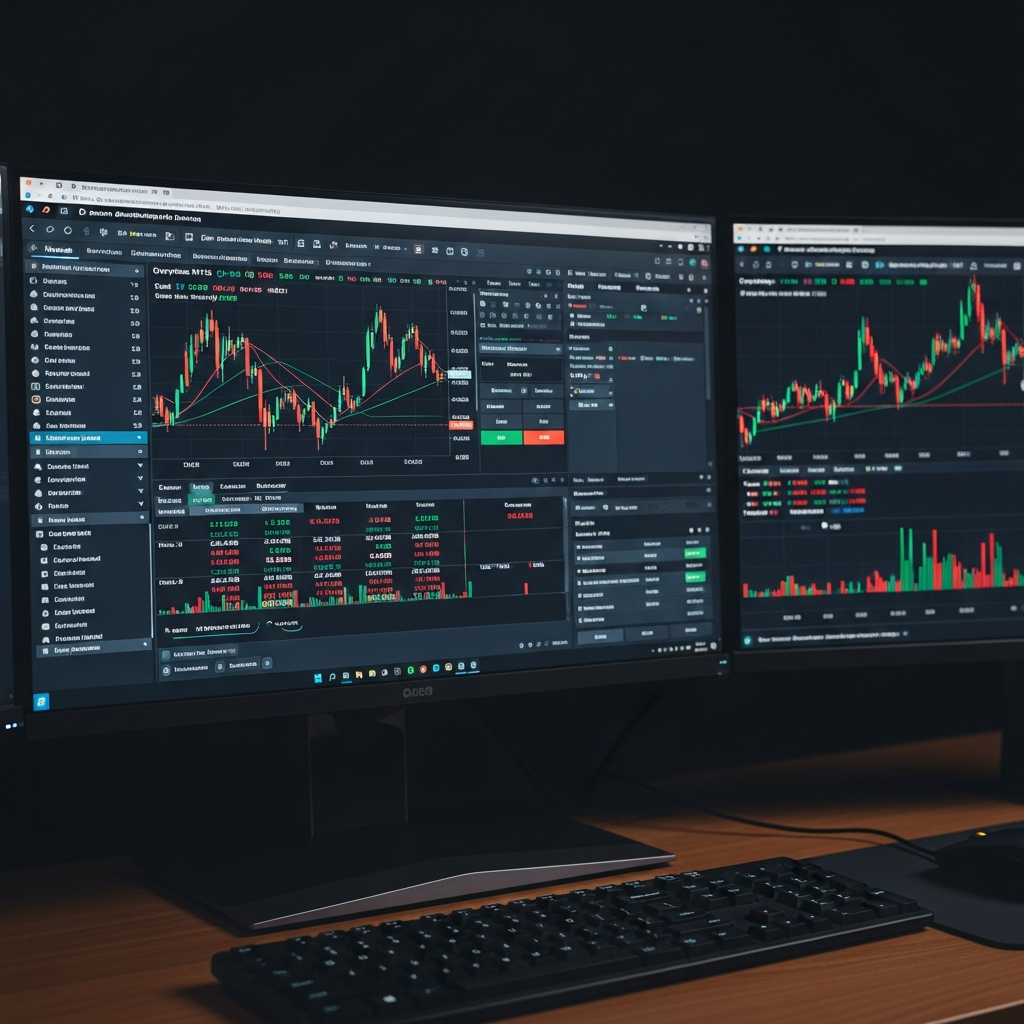
Modern arbitrage is now a game of milliseconds. We focus on two primary types: cross-exchange arbitrage and triangular arbitrage. Both require sophisticated software that can scan thousands of price pairs instantly. An MT5 indicator designed for this purpose doesn’t just show you a chart; it acts as a nerve center, aggregating data feeds from various decentralized and centralized exchanges to highlight actionable spreads.
Why MetaTrader 5 Remains the Professional Choice
You might wonder why we use MT5 for crypto, an asset class born on the web. The answer lies in the infrastructure. MT5 allows for ‘Market Depth’ (Level 2 data) and has a more advanced MQL5 programming language than its predecessor, MT4. This allows for the creation of indicators that can handle the massive data throughput required for crypto arbitrage.
High-Speed Data Processing
Crypto markets never sleep, and they produce a staggering amount of data. A well-coded MT5 indicator can process tick data much faster than a standard browser-based TradingView script. In 2026, where execution speed is the primary barrier to entry, the efficiency of C++ based MQL5 is a significant advantage.
Multi-Asset Integration
MT5 was designed to be multi-asset. This means your arbitrage indicator can simultaneously monitor Bitcoin futures, spot prices, and even correlated traditional assets like the NASDAQ or the Dollar Index (DXY). This holistic view is crucial for ‘Statistical Arbitrage,’ where traders look for price deviations between correlated assets rather than just the same asset on different exchanges.
Anatomy of a High-Performance Crypto Arbitrage MT5 Indicator
Not all indicators are created equal. If you are looking for a tool to navigate the 2026 markets, it must possess several key features to be considered professional-grade.
1. Real-Time Latency Monitoring
Profit in arbitrage is often eaten by ‘slippage’—the difference between the price you see and the price you get. A premium MT5 indicator will include a latency monitor that tells you exactly how many milliseconds it takes for your order to reach the exchange server. If latency spikes, the indicator should automatically signal a ‘no-trade’ zone.
2. Net-of-Fee Calculation
This is where most amateur traders fail. A 0.2% price gap looks great until you realize the exchange takes 0.1% on the buy side, 0.1% on the sell side, and there is a withdrawal fee. A sophisticated indicator performs ‘real-time fee netting.’ It only highlights opportunities that are profitable *after* all commissions and gas fees (for on-chain trades) are accounted for.
3. Liquidity/Depth Analysis
A price gap is meaningless if there is only $10 worth of liquidity at that price. The indicator must read the order book (DOM) to ensure that the volume available at the anomalous price is sufficient to cover your trade size without moving the market against you.
Types of Arbitrage Strategies Supported by MT5
When you load an arbitrage indicator onto your MT5 terminal, you are usually looking to execute one of three strategies. Understanding these is vital for configuring your indicator settings.
Cross-Exchange Arbitrage
This is the classic form. The MT5 indicator connects to APIs of different exchanges (e.g., Binance, Kraken, and Coinbase). It monitors the ‘Ask’ price on Exchange A and the ‘Bid’ price on Exchange B. When the Ask on A is lower than the Bid on B by a predefined threshold, the indicator triggers an alert or an automated trade.
Triangular Arbitrage
This happens within a single exchange. It involves three currency pairs. For example: BTC/USD, ETH/USD, and ETH/BTC. If the implied price of ETH through the BTC pair differs from its direct USD price, a triangular loop is formed. The advantage here is that the funds never leave the exchange, eliminating transfer times and withdrawal fees.
Spatial Arbitrage (DEX to CEX)
In 2026, the bridge between Centralized Exchanges (CEX) and Decentralized Exchanges (DEX) is a hotbed for arbitrage. A specialized MT5 indicator can track liquidity pools on Uniswap or Raydium and compare them to the spot price on an exchange like Binance. This requires a ‘Bridge’ software that feeds on-chain data into the MT5 environment.
Setting Up Your MT5 Environment for Success
Simply downloading an indicator isn’t enough. To compete in 2026, your technical environment must be optimized. Here is the professional checklist for setting up a crypto arbitrage station.
The Importance of a Low-Latency VPS
You should never run an arbitrage indicator on a home computer via a standard Wi-Fi connection. The physical distance between your computer and the exchange’s servers creates too much lag. Professional traders use a Virtual Private Server (VPS) located in the same data centers as the exchanges (often in Tokyo, London, or Northern Virginia). This reduces ‘ping’ to sub-millisecond levels.
API Integration and Security
Your MT5 indicator will need to communicate with exchanges via API keys. Security is paramount. Always use keys with ‘Trade’ permissions enabled but ‘Withdrawal’ permissions strictly disabled. In 2026, many traders also use IP-whitelisting, ensuring that even if an API key is leaked, it can only be used from the specific IP address of their VPS.
Risk Management: The Silent Killer of Arbitrage
Arbitrage is often marketed as ‘risk-free’ profit. This is a dangerous misconception. While market direction risk is neutralized, ‘operational risk’ is high. A professional MT5 indicator helps mitigate these, but the trader must be aware of them.
Execution Risk
This happens when you fill the first leg of your trade (the buy) but the price moves before you can fill the second leg (the sell). This leaves you with an unhedged position in a volatile market. Advanced indicators use ‘Fill-or-Kill’ (FOK) or ‘Immediate-or-Cancel’ (IOC) order types to prevent this.
Platform and Exchange Risk
In the fast-moving world of crypto, exchanges can go offline, or APIs can lag during high volatility. A good indicator will have a ‘kill switch’ that halts all activity if it detects that an exchange’s data feed has become stale (not updated in X seconds).
The Future: AI-Enhanced Arbitrage in MT5
As we look further into 2026, the integration of Artificial Intelligence within MT5 indicators is becoming standard. We are seeing ‘Predictive Arbitrage’ tools that don’t just look for current gaps, but use machine learning to predict where a gap is *likely* to form based on order flow imbalances. This allows traders to position themselves ahead of the move rather than chasing it.
The Shift to Cross-Chain Opportunities
With the proliferation of Layer 2 solutions and sidechains, the new frontier is ‘Bridge Arbitrage.’ Indicators are now being developed to track the price of ‘wrapped’ assets across different blockchains. If Wrapped Bitcoin (WBTC) on Arbitrum is trading at a discount to WBTC on Optimism, the MT5 indicator can signal a cross-chain move.
Conclusion: Is a Crypto Arbitrage MT5 Indicator Worth It?
The answer depends on your expectations. If you are looking for a ‘magic button’ that generates passive income without effort, you will likely be disappointed. However, if you view a crypto arbitrage MT5 indicator as a precision instrument—much like a high-performance engine in a racing car—it can give you a significant edge.
Success in 2026 requires a combination of the right software, a low-latency infrastructure, and a deep understanding of market mechanics. By utilizing the advanced features of MetaTrader 5 and pairing them with a sophisticated, fee-aware indicator, you can carve out a profitable niche in the most exciting financial market of our time. Remember, in the world of arbitrage, the profit isn’t in the big wins, but in the thousands of tiny victories executed with robotic precision.