
The Evolution of Market Forecasting: Mastering Neural Network Price Indicators
The Algorithmic Arms Race: Why Neural Networks Rule the 2026 Markets
For decades, retail and institutional traders relied on linear tools like Moving Averages, RSI, and MACD to navigate the financial markets. While these indicators provided a basic framework, they shared a fundamental flaw: they were lagging. They reacted to what the market had already done, rather than predicting what it would do next. Fast forward to 2026, and the landscape has shifted entirely. The rise of the neural network price prediction indicator has turned the tables, offering a non-linear approach to market forecasting that adapts to volatility in real-time.
Today’s markets are faster and more complex than ever. With high-frequency trading (HFT) bots and institutional AI liquidity engines dominating the tape, traditional technical analysis often falls short. A neural network indicator doesn’t just look at price; it processes multi-dimensional data points—from order flow and volume profiles to sentiment analysis and macroeconomic shifts—to identify patterns invisible to the human eye. This article explores the mechanics, the methodology, and the practical application of these sophisticated tools in modern trading.
What Exactly is a Neural Network Price Prediction Indicator?
At its core, a neural network is a computational model inspired by the human brain’s structure. It consists of layers of interconnected nodes (neurons) that process information. When applied to price prediction, these networks take historical data as input, pass it through multiple “hidden layers” where complex weights and biases are applied, and produce a forecast as an output.
Unlike a standard indicator that follows a fixed mathematical formula (like Price / Time), a neural network learns. Through a process called backpropagation, the indicator compares its predicted price against the actual market outcome. If it’s wrong, it adjusts its internal parameters to minimize error in the next calculation. This self-correcting nature is what makes AI-driven indicators far more robust in 2026 than the rigid scripts of the 2010s.
The Architecture of Prediction
To understand how these indicators function on your charting platform, we need to look at the three primary architectures currently used by top-tier traders:
- Recurrent Neural Networks (RNNs): These are designed for sequential data. They have a “memory” that allows them to understand the importance of recent price action in the context of the larger trend.
- Long Short-Term Memory (LSTM): A specialized version of RNNs that solves the “vanishing gradient” problem. LSTMs are exceptionally good at remembering long-term trends while filtering out short-term market noise.
- Transformer Models: The tech behind modern LLMs has been adapted for time-series forecasting. Transformers use “attention mechanisms” to weigh the significance of different historical price points simultaneously, making them the gold standard for 2026 volatility prediction.
Why 2026 is the Year of AI-Integrated Trading
If you had asked a professional trader in 2020 about neural network indicators, they might have called them “overfit” or “black boxes.” However, the maturation of decentralized computing and the availability of high-quality data have changed the narrative. In 2026, we have moved past simple price-in/price-out models. The modern neural network indicator is multi-modal.
This means the indicator isn’t just looking at the candles on your screen. It is simultaneously processing social media sentiment from decentralized platforms, tracking whale movements on-chain (for crypto), and monitoring central bank digital currency (CBDC) flow. By the time a human trader notices a breakout, the neural network has already analyzed the underlying cause and projected the most likely exit target.
Breaking Down the Data Pipeline
A high-performance neural network indicator follows a rigorous pipeline before it prints a signal on your chart:
- Data Normalization: Raw price data is erratic. AI indicators normalize this data into a format (usually between 0 and 1) that the network can digest efficiently.
- Feature Engineering: The indicator selects relevant features. Instead of just “closing price,” it might look at the “standard deviation of the last 50 bars” or the “rate of change in buy-side volume.”
- Inference: The trained model runs the current live data through its weights to predict the next $N$ bars.
- Confidence Scoring: The best indicators in 2026 don’t just give a ‘Buy’ or ‘Sell.’ They provide a confidence percentage, helping traders manage their position sizing based on the probability of success.
Practical Implementation: How to Use AI Indicators Today
You don’t need a PhD in data science to utilize these tools anymore. Many modern charting platforms have integrated Python-based backends that allow for real-time neural network inference. Whether you are using a proprietary institutional terminal or a consumer-grade web platform, the implementation usually falls into two categories: Overlays and Oscillators.
1. The Predictive Overlay
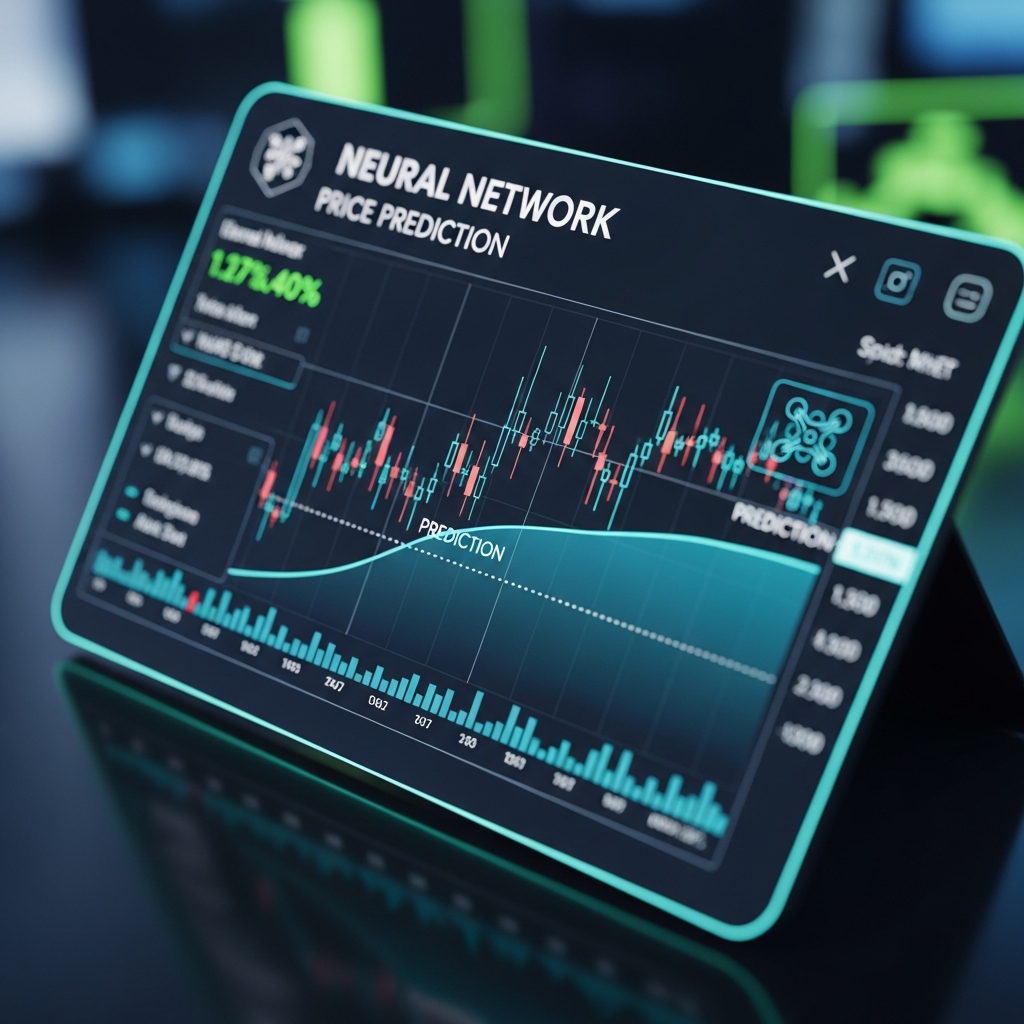
This appears as a “ghost” candle or a shaded area on your main chart. It visualizes the expected price path for the next several periods. Professional traders use this not as a crystal ball, but as a map of potentiality. If the predictive overlay suggests a 5% move upward but the actual price starts dumping, it signals a massive divergence, often leading to an even more significant trading opportunity.
2. The AI Momentum Oscillator
Traditional oscillators like the RSI can stay “overbought” for weeks during a strong bull run. A neural network-based oscillator adjusts its boundaries based on market regime. It recognizes when a market has shifted from a ranging environment to a trending one, preventing the common mistake of shorting a runaway bull market based on an antiquated RSI reading.
The Pitfalls: Why AI Isn’t a Magic Bullet
Despite the power of neural network price prediction indicators, they are not infallible. The biggest threat to an AI trader in 2026 remains overfitting. This occurs when a model is trained too specifically on historical data, essentially “memorizing” the past rather than learning how to generalize for the future. When the market dynamics change—due to a black swan event or a sudden regulatory shift—an overfitted model will fail spectacularly.
Furthermore, the “Black Box” problem persists. Because neural networks involve millions of weight adjustments, it can be difficult to explain why an indicator is predicting a crash. This lacks the transparency of a simple trendline or a Fibonacci retracement level. Successful traders in 2026 use AI indicators as a confluence tool rather than a sole source of truth.
The Human-AI Synergy: The Winning Strategy
The most profitable traders in the current era are not the ones who have completely stepped away from the screens. They are the “centaur” traders—humans who use neural network indicators to filter the noise. While the AI handles the data processing and pattern recognition, the human trader provides the contextual oversight.
For example, a neural network might predict a bullish continuation based on technical patterns, but a human trader knows that a major geopolitical announcement is scheduled for 2:00 PM. By combining the indicator’s predictive power with human situational awareness, you create a system that is significantly more resilient than either one alone.
Risk Management in the Age of AI
With the speed of AI-driven markets, risk management has had to evolve. Static stop-losses are often hunted by liquidity-seeking algorithms. Modern traders use AI-calculated dynamic stops. These are stop-loss levels that are placed based on the predicted volatility (ATR) and the neural network’s confidence interval. If the indicator detects that the market’s structure has fundamentally changed, it can signal to tighten the stop or exit the position before the price even hits the original target.
Looking Ahead: The Future of Neural Network Indicators
As we move deeper into 2026, the technology is only getting more accessible. We are seeing the rise of “Edge-AI” indicators that run locally on a trader’s hardware, ensuring zero-latency execution. We are also seeing the emergence of Reinforcement Learning (RL) indicators. Unlike traditional neural networks that are trained on static datasets, RL indicators are given an objective—maximize profit—and they learn by “playing” the market in simulated environments, constantly evolving their strategies as market conditions change.
The barrier to entry has lowered, but the ceiling for mastery has risen. To stay competitive, traders must familiarize themselves with the logic behind these tools. Understanding the difference between a simple feed-forward network and a complex transformer-based price indicator can be the difference between a winning year and a liquidating one.
Conclusion
The neural network price prediction indicator is no longer a tool of the future; it is the standard of the present. In the high-stakes environment of 2026, clinging to 20th-century technical analysis is a recipe for obsolescence. By embracing the non-linear, adaptive power of machine learning, traders can gain a profound edge in understanding market direction and volatility.
However, the key to longevity in this game remains unchanged: discipline, risk management, and the understanding that no tool—no matter how advanced—can predict the future with 100% certainty. Use the neural network as your compass, but keep your hand on the wheel. The fusion of artificial intelligence and human intuition is, and will remain, the most powerful force in the financial markets.
Whether you are a day trader looking for an intraday edge or a long-term investor seeking better entry points, integrating neural network indicators into your workflow is the most logical step forward in your trading journey. The data is there; the technology is ready. The only question is whether you are prepared to trade with the precision of 2026, or if you’ll stay stuck in the past.