
The Impact of CBDCs on the Forex Market in 2026: A New Era for Global Trading
The 2026 Digital Revolution: CBDCs and the New Forex Paradigm
As we navigate through 2026, the global financial landscape has undergone a transformation more profound than any shift seen since the Bretton Woods Agreement. The rise of Central Bank Digital Currencies (CBDCs) has moved from theoretical whitepapers and small-scale pilots to the core of the international monetary system. For the foreign exchange (Forex) market, which remains the largest and most liquid financial market in the world, the arrival of CBDCs has signaled the end of the traditional correspondent banking era and the birth of ‘Atomic FX’.
In 2026, over 45 countries have launched or are in the advanced stages of deploying sovereign digital currencies. This shift has fundamentally altered how currencies are traded, settled, and held as reserves. This article explores the multifaceted impact of CBDCs on the Forex market in 2026, examining everything from settlement speeds to the geopolitical shifts in reserve currency dominance.
The End of T+2: Atomic Settlement and Instant Liquidity
For decades, the standard for Forex settlement was T+2—meaning it took two business days for funds to actually change hands after a trade was executed. In 2026, this legacy system is rapidly being replaced by ‘Atomic Settlement.’ Enabled by distributed ledger technology (DLT) and wholesale CBDCs, atomic settlement allows for the simultaneous exchange of two currencies in real-time.
Eliminating Counterparty Risk
One of the primary impacts on the Forex market in 2026 is the near-total elimination of Herstatt risk (settlement risk). Because CBDCs allow for Delivery vs. Payment (DvP) or Payment vs. Payment (PvP) on a 24/7 basis, the window of time where one party has delivered currency but not yet received the other is gone. This has led to a significant reduction in the capital requirements for major liquidity providers, as the need for ‘buffer’ capital to cover settlement gaps has diminished.
24/7 Market Operations
Traditionally, the Forex market followed the sun, with liquidity dipping during the ‘Downtime’ between the New York close and the Tokyo open. However, in 2026, programmable CBDCs and automated market makers (AMMs) operating on sovereign blockchains have ensured that deep liquidity is available even on weekends and bank holidays. The ‘market never sleeps’ adage has finally become a technical reality, not just a metaphor.
The Rise of Multi-CBDC (mBridge) Platforms
The most significant architectural change in 2026 is the maturity of multi-CBDC platforms, most notably Project mBridge. This platform, which connects the digital yuan (e-CNY), the digital dirham, and several other Asian and Middle Eastern CBDCs, has created a direct bridge for cross-border payments that bypasses the traditional SWIFT network.
Bypassing Correspondent Banks
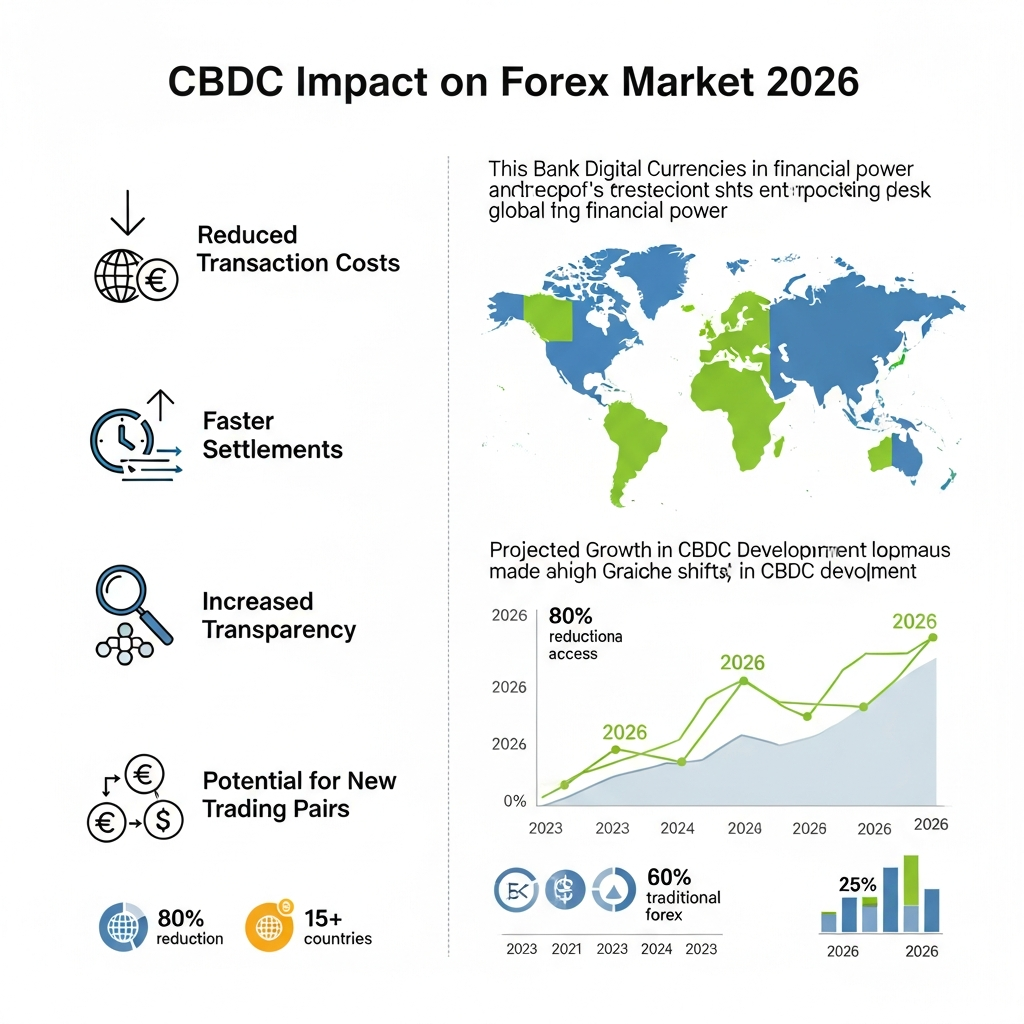
In the pre-2026 era, a trade between the Thai Baht and the UAE Dirham often required a correspondent bank and a conversion into US Dollars as an intermediary step. Today, mBridge allow for direct peer-to-peer exchange between central bank ledgers. This has reduced transaction costs by an estimated 40% for corporate entities and has significantly narrowed the bid-ask spreads for ‘exotic’ or minor currency pairs.
Regionalization vs. Globalization
We are seeing a trend toward regional digital currency blocs. In 2026, the Eurozone’s e-Euro and the digital currencies of the Eastern European nations have integrated into a high-speed ‘Digital Corridor.’ This regionalization is creating new volatility patterns, as economic shocks are transmitted instantly across these interconnected ledgers, requiring traders to adopt new algorithmic strategies that account for ‘ledger latency’ rather than just traditional economic indicators.
De-dollarization and the Shift in Reserve Dynamics
Perhaps the most debated topic of 2026 is the impact of CBDCs on the US Dollar’s status as the world’s primary reserve currency. While the ‘Digital Dollar’ pilot programs have successfully maintained USD liquidity, the ease of using other CBDCs for international trade has chipped away at the greenback’s dominance.
The Programmable Yuan and Trade Settlements
The e-CNY has seen massive adoption in 2026 across the ‘Belt and Road’ initiatives. By embedding ‘smart contracts’ into trade agreements, Chinese exporters can ensure payment is automatically released upon the digital verification of shipping documents (e-bills of lading). This functionality has made the digital yuan a highly attractive currency for B2B trade settlement, increasing its share of daily Forex volume significantly compared to five years ago.
Diversification into ‘Digital Gold’ and Multi-Currency Baskets
Central banks in 2026 are no longer just holding physical gold and fiat bonds. They are holding diversified portfolios of wholesale CBDCs. The Forex market has had to adapt to this ‘rebalancing act.’ When a central bank rebalances its digital ledger, the movement is visible (though often pseudonymized) on the chain, leading to a new form of ‘On-Chain Analysis’ for Forex traders who previously relied solely on COT reports and interest rate parity models.

Market Volatility and the Role of Algorithmic Trading
In 2026, the nature of Forex volatility has changed. While the elimination of settlement delays has stabilized some aspects of the market, the ‘programmability’ of money has introduced new types of flash crashes.
Smart Contract Triggers
Many institutional trades in 2026 are governed by smart contracts. If a certain exchange rate is hit, thousands of contracts might trigger simultaneous CBDC swaps. This can lead to intense, micro-second liquidity drains. Professional traders have pivoted toward ‘Quantum-Resistant Algorithms’ to navigate these digital liquidity pools. The speed of execution is no longer measured in milliseconds, but in the time it takes for a block to be validated on a sovereign ledger.
Transparency vs. Privacy
The Forex market in 2026 operates under a ‘Glass House’ paradox. While central banks have greater visibility into capital flows to prevent money laundering (AML), the transparency of these large-scale movements has made it harder for institutional players to hide their ‘hand.’ Consequently, new privacy-preserving technologies like Zero-Knowledge Proofs (ZKPs) have been integrated into CBDC layers to allow for institutional anonymity while maintaining regulatory compliance.
The Retail Experience: 2026 Forex Trading
For the retail trader in 2026, the barrier to entry has changed. Most retail brokers now offer ‘Direct CBDC Wallets.’ Instead of depositing funds into a brokerage account and waiting for a withdrawal, traders trade directly from their digital sovereign wallets.
Lower Fees and Instant Withdrawals
The friction of moving money between a bank account and a trading platform has evaporated. In 2026, when a trader closes a position in the GBP/USD pair, the profit is instantly reflected in their e-Sterling or Digital Dollar wallet. This has led to an explosion in ‘Micro-Forex’ trading, where individuals trade small amounts of currency based on real-time travel needs or instant e-commerce requirements.
The Integration of AI and Personal Finance
By 2026, AI assistants are integrated with CBDC wallets. These AIs automatically perform ‘Micro-Hedging’ for individuals. For example, if an American citizen is planning a trip to Japan, their AI might gradually convert Digital Dollars to Digital Yen over several weeks whenever the exchange rate is favorable, effectively making every citizen a participant in the Forex market.
Regulatory Landscape: The 2026 Framework
Regulatory bodies like the BIS (Bank for International Settlements) have established the ‘Unified Ledger Framework’ in 2026. This framework ensures that different CBDCs are interoperable. Without this, the Forex market would have fragmented into isolated ‘digital islands.’
Automated Compliance
Compliance is no longer a back-office function. In 2026, tax obligations and AML checks are embedded into the CBDC units themselves. If a Forex trade exceeds a certain threshold or involves a flagged ‘wallet,’ the smart contract governing the trade may automatically escrow a portion of the funds for tax or flag it for human review. This ‘RegTech’ integration has made the Forex market of 2026 more secure but also more heavily monitored than ever before.
Conclusion: The Path Ahead for Forex
As we look at the remainder of 2026 and beyond, the impact of CBDCs on the Forex market is undeniable. We have moved from a system of ‘trust in intermediaries’ to a system of ‘trust in code and sovereign ledgers.’ The efficiency gains are massive, but the challenges—ranging from the loss of dollar hegemony to the risks of algorithmic contagion—are equally significant.
For traders, investors, and policymakers, the message of 2026 is clear: the digital currency revolution is no longer coming; it is already here. Success in the Forex market now requires a deep understanding of blockchain interoperability, smart contract logic, and the shifting geopolitical alliances that define the digital currency blocs of the modern age. The Forex market has been reborn, and it is faster, more transparent, and more complex than we ever imagined it would be.