
The Next Phase of Algorithmic Trading: Mastering AI-Driven Trend Prediction on MT5
The Evolution of Market Analysis: Why Static Indicators are Fading
For decades, the retail trading landscape was dominated by lagging indicators. Traders relied on Moving Averages, the Relative Strength Index (RSI), and Bollinger Bands to make sense of price action. While these tools served their purpose in slower, more predictable markets, the environment of 2026 has rendered many of these legacy methods obsolete. The sheer volume of high-frequency data and the interconnectedness of global liquidity pools require something more robust than a simple mathematical average of the last 14 candles.
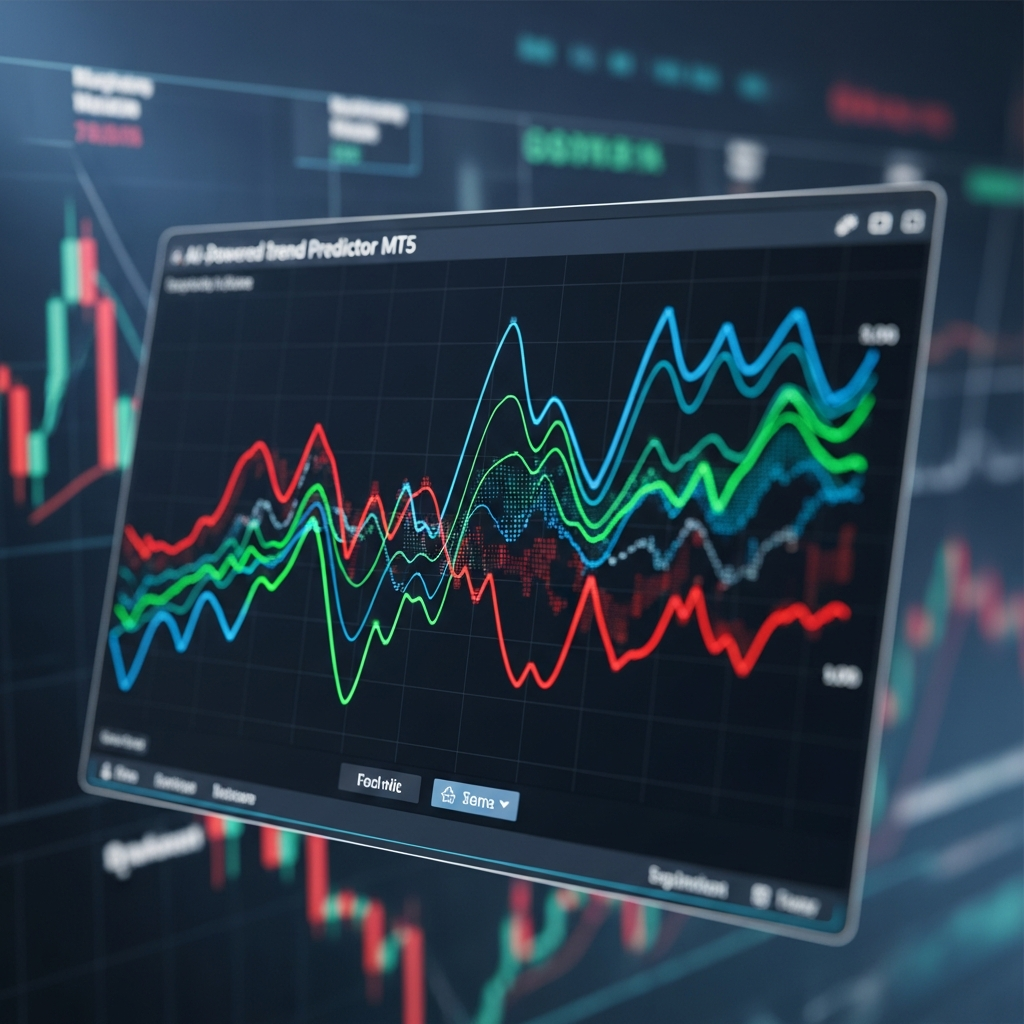
Enter the AI-powered trend predictor for MetaTrader 5 (MT5). This is not just a cosmetic upgrade to the classic technical analysis suite; it represents a fundamental shift in how we interpret market structure. By leveraging deep learning and neural networks directly within the MT5 environment, traders are now able to move from reactive analysis to predictive modeling.
Understanding the Architecture of an AI-Powered MT5 Predictor
To appreciate the power of these tools, one must look under the hood. Unlike a standard Expert Advisor (EA) that follows a rigid ‘if-then’ logic, an AI trend predictor utilizes machine learning models—most commonly Recurrent Neural Networks (RNN) or Long Short-Term Memory (LSTM) architectures. These models are specifically designed to recognize patterns in time-series data, which is exactly what a price chart is.
Neural Networks and MQL5 Integration
In 2026, the integration between MetaTrader 5 and external Python-based AI libraries has become seamless. Modern trend predictors often perform the heavy computational lifting in a Python environment, using libraries like TensorFlow or PyTorch, and then feed the predictive signals back into the MT5 terminal via high-speed APIs. This allows the predictor to analyze thousands of data points—including volume, volatility, and even sentiment—simultaneously.
The Role of Multi-Threaded Backtesting
One of the reasons MT5 has become the preferred platform for AI-driven tools is its multi-threaded strategy tester. In the past, training an AI model was a time-consuming process that could take days. Today, using MT5’s distributed cloud computing network, traders can optimize their predictive models against years of tick-perfect data in a fraction of the time. This ensures that the trend predictor is not just ‘overfitting’ to past data but is actually learning the underlying mechanics of market movement.
The Key Benefits of AI Trend Prediction in 2026
The transition to AI-assisted trading is driven by several competitive advantages that traditional traders simply cannot match. Here is why the shift is becoming mandatory for those seeking a professional edge.
1. Elimination of Cognitive Bias
Human traders are biologically wired to fail at trading. We suffer from confirmation bias, loss aversion, and the ‘gambler’s fallacy.’ An AI trend predictor has no such baggage. It analyzes the probability of a trend continuation based on objective mathematical weights. If the data suggests a 65% probability of a trend reversal, the AI signals it, regardless of how ‘bullish’ the news might feel.
2. Real-Time Sentiment Analysis
Modern AI predictors on MT5 don’t just look at price. They are often fed ‘alternative data’ streams. By the time 2026 arrived, the most successful predictors were integrating real-time news sentiment and social media velocity into their trend forecasts. If a sudden geopolitical event occurs, the AI can adjust its trend prediction seconds before the retail crowd has even finished reading the headline.
3. Adaptive Learning Rates
The market is a dynamic organism. A strategy that works in a high-volatility environment may fail during a period of consolidation. AI trend predictors use a process called ‘online learning,’ where the model continues to update its parameters as new data flows in. This allows the tool to adapt to ‘regime shifts’ in the market—something a standard Moving Average Crossover simply cannot do.
Implementing an AI Predictor: A Practical Guide
If you are looking to integrate an AI-powered trend predictor into your MT5 setup, the process involves more than just dragging and dropping an indicator onto a chart. It requires a disciplined approach to configuration and risk management.
Data Preprocessing and Feature Selection
The quality of an AI’s prediction is only as good as the data it receives. In the context of MT5, this means selecting the right ‘features.’ Traders must decide which data points the AI should prioritize. Common features include:
- Average True Range (ATR): For measuring market ‘noise.’
- Rate of Change (ROC): To gauge momentum.
- Order Flow Data: Analyzing the ‘tape’ to see where the big money is positioning.
Setting the Prediction Horizon
Are you a scalper or a swing trader? AI predictors allow you to set a ‘prediction horizon.’ For a day trader, the AI might be trained to predict the trend for the next 5 to 15 minutes. For a long-term investor, the model might look at the probability of where the price will be at the end of the trading week. Choosing the right horizon is critical for aligning the AI’s output with your specific trading style.
The Risks of Relying Solely on AI
While the benefits are immense, it is dangerous to view an AI trend predictor as a ‘black box’ that prints money. There are specific risks that 2026 traders must remain vigilant about.
The Problem of Over-Optimization
It is possible to make an AI model look perfect on historical data. This is known as ‘curve fitting.’ If an AI predictor is too specific to past market conditions, it will fail miserably when faced with a new, unique market event. Professional traders always look for models that show ‘walk-forward’ stability rather than just high historical returns.
Latency and Execution
A prediction is only useful if it can be acted upon. In high-frequency environments, the time it takes for the AI to process data and send a signal to the MT5 server (latency) can eat into profit margins. Utilizing a high-quality Virtual Private Server (VPS) located near the broker’s data center is essential for maintaining the integrity of the AI’s predictions.
The Future of Retail Trading: Why 2026 is a Turning Point
As we navigate through 2026, the gap between ‘AI-enabled’ traders and ‘traditional’ traders is widening. The complexity of the markets has reached a point where the human brain, unaided by machine learning, struggles to process the relevant variables in real-time. MetaTrader 5 has evolved from a simple charting platform into a sophisticated data terminal, and the AI trend predictor is its most powerful instrument.
The goal is not to replace the trader, but to augment their capabilities. By handling the heavy lifting of pattern recognition and probability calculation, the AI allows the human trader to focus on high-level strategy and capital allocation. This synergy between human intuition and machine precision is the hallmark of the modern era.
Conclusion
The AI-powered trend predictor for MT5 is more than a trend; it is the new standard. As machine learning algorithms become more accessible and the computational power of MT5 continues to expand, the ability to forecast market movements with statistical significance is no longer reserved for institutional hedge funds. Whether you are trading Forex, Equities, or Commodities, integrating artificial intelligence into your trend analysis is the most logical step toward long-term profitability in the ever-evolving markets of 2026. The future of trading isn’t just about working harder; it’s about trading smarter through the power of predictive technology.