
The Truth About Prop Firm Passing EAs in 2026: A Comprehensive Review
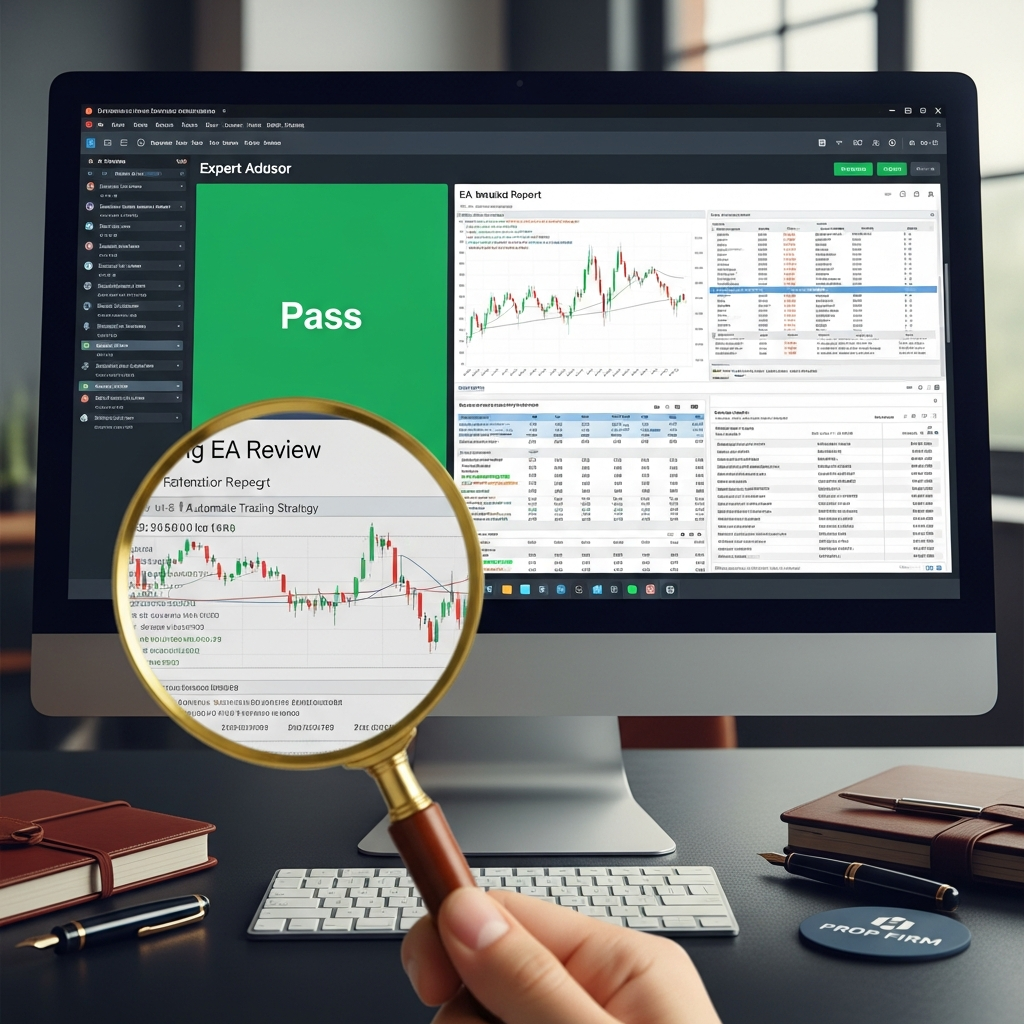
Beyond the Manual Grind: A Deep Dive into Prop Firm Passing EAs for 2026
The landscape of proprietary trading has undergone a seismic shift over the last few years. If 2026 was the year of the ‘Prop Firm Boom,’ 2026 is officially the year of the ‘Automated Evolution.’ The days of traders sitting in front of six monitors, drinking lukewarm coffee, and hunting for a 1:3 Risk-to-Reward setup on the 5-minute chart are fading. Today, the conversation is dominated by Expert Advisors (EAs)—specifically, those designed to navigate the rigorous evaluation phases of funding programs.
Using a prop firm passing EA is no longer a fringe tactic used by tech-savvy outliers; it has become a standard approach for traders looking to scale their capital without the emotional fatigue of manual execution. However, as the technology has advanced, so too have the rules. In this review, we analyze the current state of automated passing, the tech behind the bots, and the firms that are leading the pack in 2026.
The Evolution of the Prop Trading Landscape
In the early 2020s, prop firms were largely skeptical of automated systems. Many banned them outright or buried restrictive clauses in their Terms of Service. Fast forward to 2026, and the industry has matured. Firms have realized that profitable algorithms provide liquidity and data that are just as valuable as manual trades. The emergence of high-speed servers and the integration of AI-driven risk management tools within the firms themselves have leveled the playing field.
However, this doesn’t mean it’s a ‘set and forget’ gold mine. The relationship between a trader’s EA and the firm’s broker is more complex than ever. Slippage, latency, and ‘IP clustering’ are now the primary battlegrounds where challenges are won or lost.
Understanding How Prop Firm Passing EAs Actually Work
Not all bots are created equal. When someone mentions a ‘passing EA,’ they are usually referring to one of three distinct algorithmic architectures. Understanding which one you are using is critical to ensuring you don’t violate the specific rules of your chosen firm.
1. HFT Bots (High-Frequency Trading)
HFT bots are the most popular choice for passing ‘no-time-limit’ or ‘unlimited’ challenges. These algorithms exploit micro-inefficiencies in the spread, opening and closing hundreds of trades within milliseconds. In 2026, many firms specifically cater to HFT users, offering ‘HFT-friendly’ accounts where the evaluation can be passed in as little as twenty minutes. While incredibly effective for passing, these bots are rarely used on live/funded accounts because the slippage on a real server would eat the profits instantly.
2. Grid and Martingale Variants
These EAs rely on mathematical probability rather than market direction. They scale into positions as the price moves against them, aiming for a small retracement to close the entire ‘basket’ in profit. While these are highly effective at maintaining a smooth equity curve during quiet markets, they are the ‘black sheep’ of the prop world. Many firms in 2026 have implemented ‘Consistency Rules’ or ‘Maximum Position Limits’ specifically to throttle the risk associated with these bots.
3. Smart Trend-Followers (The Hybrid Approach)
The most sophisticated EAs in 2026 utilize machine learning to identify market structures. They don’t just look at RSI or Moving Averages; they analyze order flow and sentiment. These are ‘Passing and Management’ bots. They are designed to pass the challenge slowly and conservatively, mimicking the behavior of a professional human trader, which makes them highly valued by firms that want to copy the trades of their funded participants.
Choosing the Right EA: Features That Matter Most in 2026
If you are looking for an EA to pass your next $100k or $200k challenge, you cannot rely on old MT4 code from 2019. Modern prop firms use sophisticated ‘bot detection’ software to ensure their traders aren’t all using the exact same ‘set file.’ If 500 traders use the same bot with the same settings, the firm faces a massive concentrated risk.
Key features to look for include:
- IP Randomization: The ability for the EA to communicate through various proxies so your trades don’t look like they belong to a ‘copy-farm.’
- Equity Protectors: A hard-coded ‘kill switch’ that closes all positions if the daily loss reaches 4.5% (assuming a 5% limit), protecting you from sudden market spikes.
- News Filters: In 2026, almost every firm bans trading during high-impact news. A high-quality EA must have an integrated economic calendar to pause trading automatically.
- Slippage Control: The bot should check the spread before entering. If the spread is too wide, the EA stays out, preventing the ‘death by a thousand cuts’ that many automated systems face.
The 2026 Regulatory Environment: Can Firms Detect Your Bot?
The short answer is: Yes. The longer answer is: They only care if you are breaking the rules. In 2026, the ‘detection’ isn’t about whether you are using a robot; it’s about whether you are using a prohibited robot. Firms look for ‘Toxic Flow’—strategies that exploit demo environment glitches rather than actual market movements.
Firms also look for ‘Identical Trading.’ If you buy a cheap $50 bot from a popular marketplace and use the default settings, the prop firm’s backend will flag you instantly. To pass successfully in 2026, you must customize your parameters. Even changing your ‘Magic Number,’ your lot size by 0.01, or your take-profit by a few pips can help differentiate your account from the thousands of others running the same logic.
Setting Up for Success: Technical Requirements
You cannot run a prop firm passing EA on your home laptop. The internet connection is too unstable, and the latency is too high. Successful automated traders in 2026 utilize specialized Virtual Private Servers (VPS).
A trading-optimized VPS should be located in the same data center as the firm’s broker (usually London, New York, or Tokyo). This reduces latency to sub-1ms levels. In the world of HFT and rapid-execution EAs, a 20ms delay can be the difference between a 1% gain and a 2% loss due to slippage. Most premium EAs now come with a ‘VPS-check’ feature that won’t even allow the bot to initialize unless the latency is within an acceptable range.
Pitfalls and Why Most EAs Fail the Challenge
Despite the power of automation, the failure rate for prop challenges remains high—even for those using EAs. Why? Usually, it’s human interference. It is a psychological paradox: traders buy a bot to remove emotion, but then they get nervous and turn the bot off during a drawdown, or manually close a trade that the bot would have eventually turned into a winner.
Other common failure points include:
- Over-leveraging: Setting the bot to risk 2% per trade on a firm that has a 5% total drawdown limit. One losing streak of three trades, and the account is gone.
- Ignoring the ‘Consistency Rule’: Many 2026 firms require that no single trade accounts for more than 30% of your total profit. EAs that rely on one ‘lucky’ massive win often get the account disqualified during the payout review.
- Broker Mismatch: Using an EA designed for a raw-spread broker on a standard-spread account. The math simply doesn’t hold up.
The Ethics of Using Robots to Pass Challenges
There is an ongoing debate in the community: is it ‘cheating’ to use an EA? From the firm’s perspective, the answer is usually ‘no,’ provided the trader understands the risk. The firm’s goal is to find traders (or systems) that can generate profit without violating drawdown. If a robot can do that better than a human, the firm is happy to take their cut of the profits.
However, from a trader’s development perspective, relying solely on an EA to pass without understanding market mechanics is a recipe for disaster. If the EA stops working (and all EAs eventually experience ‘alpha decay’), the trader is left with no skills to fall back on. The most successful traders in 2026 use EAs as a tool for capital acquisition, but they continue to hone their manual skills on the side.
The Future of Automated Funding
As we move deeper into 2026, we are seeing the rise of ‘AI-Coached’ EAs. These systems don’t just follow static rules; they learn from the trader’s own history. They can identify that ‘The trader usually loses on Tuesday mornings’ and automatically reduce the risk during those windows. This level of synergy between human oversight and machine execution is the current ‘gold standard’ for prop firm success.
The barrier to entry for prop firms has lowered, but the barrier to *retention* has increased. Passing the challenge is the easy part; keeping the funded account for more than three months is the real test. An EA that is designed specifically for the ‘Passing’ phase must be swapped for a ‘Conservation’ EA once the account is live.
Conclusion: Is a Prop Firm Passing EA Worth It?
In 2026, the answer is a resounding yes—with caveats. If you view an EA as a magic wand that will print money while you sleep on a beach, you will likely join the 90% of traders who fail. However, if you view it as a precision instrument to manage the ‘math’ of a challenge—handling the entries, exits, and risk calculations with a level of discipline no human can match—then it is arguably the most powerful tool in your arsenal.
Before you purchase or deploy an EA, perform your due diligence. Check the firm’s current rules regarding HFT, check the ‘Consistently’ and ‘Lurking’ rules, and always, always test the bot on a demo account for at least two weeks before committing to a paid challenge. The machines are here to stay; the question is whether you are the one controlling them, or the one being left behind in their wake.