Mastering the Algorithmic Liquidity Hunt Strategy: The 2026 Ultimate Guide
Introduction: The New Era of Market Efficiency in 2026
In the rapidly evolving financial landscape of 2026, the traditional methods of technical analysis have been largely subsumed by high-frequency execution and deep-learning models. At the heart of this transformation lies the algorithmic liquidity hunt strategy. This is not merely a trading technique; it is the fundamental mechanism by which modern markets operate. Institutional players, central banks, and hedge funds use sophisticated algorithms designed to identify and ‘hunt’ clusters of orders to facilitate their own large-scale entries and exits.
As we navigate through 2026, understanding the ‘liquidity hunt’ is no longer optional for retail traders—it is a prerequisite for survival. With the integration of quantum-enhanced processing and real-time sentiment analysis, the hunt has become faster, more precise, and more ruthless. This guide explores the intricacies of how these algorithms function and how you can align your portfolio with ‘smart money’ flows.
What is an Algorithmic Liquidity Hunt Strategy?
An algorithmic liquidity hunt occurs when large institutional algorithms deliberately drive the price toward specific zones where a high volume of pending orders—typically stop-losses or breakout entries—are located. By triggering these orders, the algorithm creates the necessary ‘counter-party’ liquidity to fill a massive position without causing significant slippage against themselves.
The Mechanics of the ‘Stop Run’
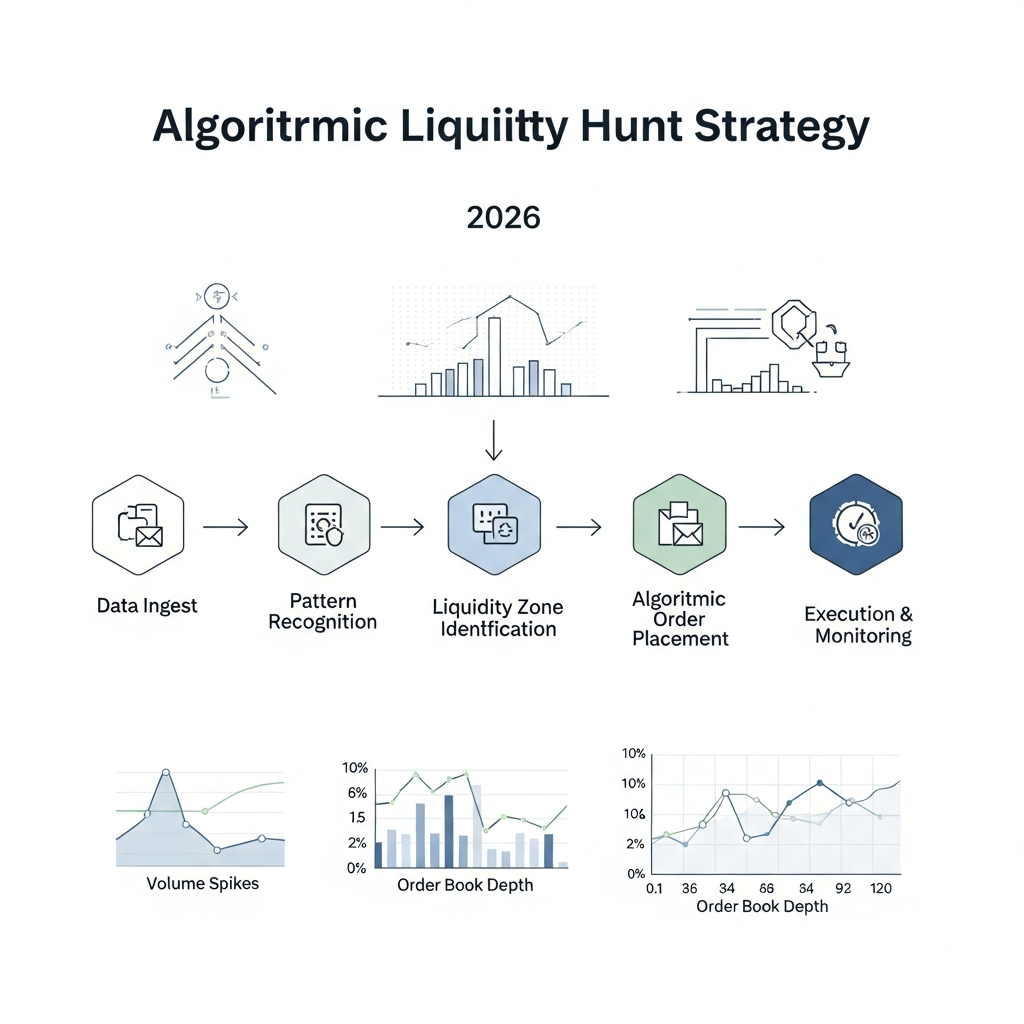
In 2026, the most common form of liquidity hunting is the ‘stop run.’ Imagine a scenario where a majority of retail traders have placed their stop-loss orders just below a well-defined support level. The institutional algorithm, recognizing this cluster via order-book depth analysis, will aggressively sell to push the price through that support. As those retail stop-losses are triggered (which are essentially ‘sell’ orders), the algorithm buys that massive influx of sell orders at a discounted price, before reversing the trend upward.
The 2026 Twist: Neural Liquidity Mapping
Unlike the static models used five years ago, the algorithms of 2026 utilize Neural Liquidity Mapping (NLM). These systems don’t just look at the current order book; they predict where liquidity will accumulate hours in advance based on historical retail behavior and social sentiment triggers. This predictive capability makes the liquidity hunt feel almost sentient to the uninitiated trader.
Identifying Liquidity Pools in 2026
To master the algorithmic liquidity hunt strategy, one must first learn to see the market through the eyes of an algorithm. This means identifying ‘liquidity pools’—areas where orders are concentrated. In the current market cycle of 2026, these pools typically reside in three specific locations:
- Equal Highs and Lows: These are ‘magnets’ for algorithms. Retail traders see double tops or double bottoms as strong reversals, placing stops just above or below them. Algorithms see them as a feast of liquidity.
- Session Extremes: The high and low of the Tokyo, London, and New York sessions are primary targets for the 2026 trading day.
- Psychological Big Figures: Round numbers (e.g., $100,000 for Bitcoin or 1.2000 for EUR/USD) continue to act as major liquidity hubs.
The Role of High-Frequency Trading (HFT) Nodes
In 2026, HFT nodes act as the ‘executioners’ of the liquidity hunt. These nodes operate in microseconds, clearing out liquidity pools before a human trader can even refresh their chart. When you see a sudden ‘wick’ on a 1-minute candle that snaps back instantly, you are witnessing a successful algorithmic hunt in action.
The Evolution of Smart Money Concepts (SMC) in 2026
Smart Money Concepts, once a niche methodology, has become the dominant framework for price action traders in 2026. However, the ‘old’ SMC rules have been refined. The algorithms are now programmed to exploit traders who use basic SMC patterns like ‘Order Blocks’ or ‘Fair Value Gaps’ without considering the broader liquidity context.
Refining the Order Block
In 2026, an Order Block is only valid if it was created by a liquidity hunt. If an order block formed without first taking out a previous high or low, the algorithm likely considers that block itself as a target for future liquidity raids. This is a crucial distinction that separates profitable 2026 traders from those still using outdated 2026 strategies.
Inducement vs. Execution
One of the most important concepts in the 2026 algorithmic landscape is ‘inducement.’ This is a move designed to trick traders into entering the market early. The algorithm creates a ‘fake’ breakout to induce retail buyers, only to reverse the price into their stops to gather the liquidity needed for the real move.

Step-by-Step Guide: Trading the Liquidity Hunt
If you want to trade alongside the algorithms in 2026, follow this strategic workflow:
Step 1: Identify the Higher-Timeframe (HTF) Narrative
Algorithms are programmed with a bias. Before looking for a hunt, determine the institutional direction on the Daily or 4-Hour chart. Are we in a distribution phase or an accumulation phase? In 2026, this is often dictated by CBDC (Central Bank Digital Currency) interest rate shifts and AI-driven economic forecasts.
Step 2: Locate the ‘External’ Liquidity
Look for the nearest significant high or low that hasn’t been touched. This is your target zone. In 2026, the ‘External Liquidity’ represents the fuel the market needs to reach its next objective.
Step 3: Wait for the ‘Raid’
Do not enter the market before the hunt. Patiently wait for price to aggressively pierce the liquidity pool. You are looking for a ‘stop-and-reverse’ signature. On a lower timeframe (e.g., 5-minute), you want to see the price take out the liquidity and then immediately close back inside the previous range.
Step 4: Confirm the Market Structure Shift (MSS)
Once the liquidity is grabbed, the algorithm will shift the local market structure. In the 2026 version of this strategy, we look for a ‘Displacement’ move—a sharp, energetic candle that leaves behind a Fair Value Gap (FVG). This proves that the ‘big money’ has successfully filled their orders and is now moving price in the desired direction.
Step 5: Entry and Risk Management
Enter on the retracement into the FVG. In 2026, risk management is more important than ever due to increased volatility. Your stop-loss should be placed just beyond the low/high of the liquidity hunt wick. If the algorithm returns to that level, the ‘hunt’ failed or is expanding, and you must exit immediately.
Tools for Tracking Liquidity in 2026
While basic charts are still used, professional traders in 2026 utilize advanced software to visualize the hunt:
- Heatmaps 2.0: Advanced depth-of-market (DOM) visualizers that show historical and real-time limit orders with 99% accuracy.
- Algorithmic Sentiment Aggregators: Tools that scan social media and news feeds using LLM-8 models to predict where retail traders are most likely to place their stops.
- On-Chain Flow Monitors: For crypto assets, tracking ‘Whale’ movements from cold storage to exchanges in real-time is a key component of identifying a pending liquidity hunt.
The Ethical and Regulatory Landscape of 2026
The rise of the algorithmic liquidity hunt strategy has not gone unnoticed by regulators. In 2026, the ‘Global Market Integrity Act’ was introduced to curb predatory spoofing (placing fake orders to move price). However, the liquidity hunt strategy itself remains a legal and necessary part of market discovery. Traders must be aware that while the ‘hunt’ is a natural function of the market, the tools used to execute it are under constant scrutiny.
The Impact of CBDCs
The introduction of Central Bank Digital Currencies in major economies has changed how liquidity is measured. With the transparency of CBDC ledgers, institutional algorithms can now analyze ‘macro-liquidity’ with unprecedented precision, making the hunting process more efficient than it was in the early 2020s.
Common Pitfalls to Avoid
Even with the best strategy, 2026 markets are unforgiving. Avoid these common mistakes:
- Front-running the Hunt: Trying to enter before the liquidity is taken is the fastest way to get ‘hunted’ yourself. Patience is the primary edge.
- Ignoring the News: In 2026, AI-generated news cycles can trigger ‘flash hunts’ that ignore technical levels. Always check the high-impact calendar.
- Over-leveraging: Algorithmic volatility in 2026 is higher than ever. High leverage during a liquidity grab can lead to liquidation before the price moves in your favor.
Conclusion: Embracing the Hunt in 2026
The algorithmic liquidity hunt strategy is the definitive signature of the 2026 financial markets. By moving away from the ‘retail mindset’ and learning to identify where orders are clustered, you transform from a target into a predator. The market is not ‘rigged’—it is simply a system seeking efficiency. In a world dominated by AI and high-frequency algorithms, your greatest asset is the ability to recognize the footprints of the whales and swim alongside them.
As we move deeper into 2026, the technology will continue to advance, but the underlying psychology of the market remains the same: price will always move toward liquidity. Master the hunt, and you master the market.