Advanced Order Flow Trading 2026: The Comprehensive Guide to Market Microstructure
The New Era of Transparency: Advanced Order Flow Trading in 2026
As we navigate the complex financial landscapes of 2026, the gap between retail enthusiasts and institutional titans has narrowed significantly. The primary driver of this convergence? Advanced order flow trading. In 2026, the reliance on lagging technical indicators like the RSI or moving averages has largely been relegated to introductory courses. Professional traders now focus exclusively on market microstructure—the study of how orders are matched and the immediate impact they have on price action.
Order flow trading is no longer just about watching a Level 2 DOM (Depth of Market). In the current year, it involves a multi-dimensional analysis of historical transactions, real-time liquidity shifts, and the integration of machine learning algorithms that can parse millions of micro-transactions in milliseconds. This guide explores the sophisticated methodologies that define the 2026 trading environment.
Why Order Flow is the Ultimate Edge in 2026
Traditional technical analysis assumes that history repeats itself. Order flow analysis, however, operates on the principle that liquidity drives price. By understanding the auction process, traders can see the struggle between buyers and sellers in real-time. In 2026, the volatility introduced by decentralized finance (DeFi) and high-frequency trading (HFT) bots requires a more granular view than a standard candlestick chart can provide.
The Shift from Lagging to Leading Data
Technical indicators are mathematical derivatives of price and time. By the time an oscillator signals an “oversold” condition, the smart money has already positioned itself based on order flow imbalances. Advanced order flow trading utilizes leading data. This includes executed volume at specific price levels (the tape) and intent shown in the limit order book.
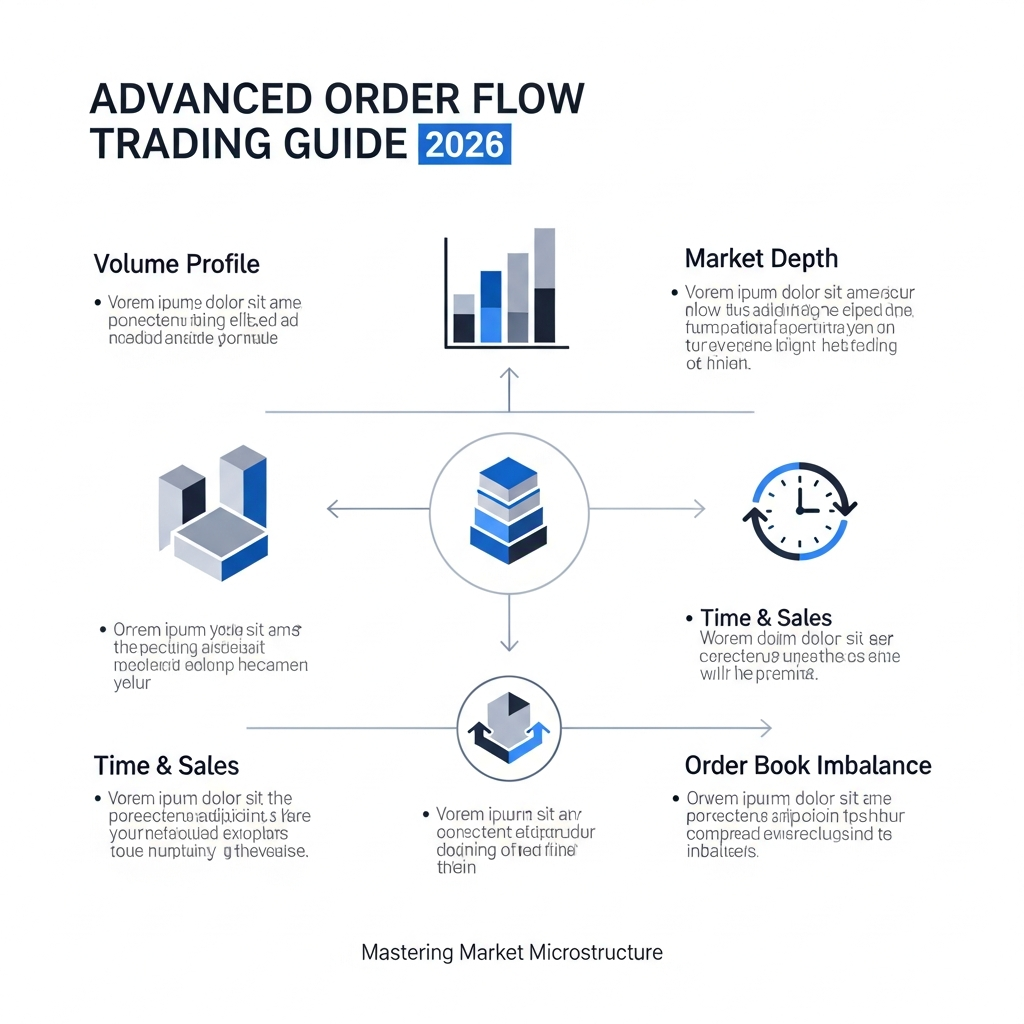
Essential Tools for the 2026 Order Flow Trader
To compete in 2026, your toolkit must evolve. Standard charting platforms are often insufficient for the sheer volume of data processed in today’s markets. Here are the core components of an advanced setup:
1. Footprint Charts (Cluster Charts)
The Footprint chart remains the cornerstone of order flow analysis. It decomposes every candle into price levels, showing exactly how many contracts were bought at the ask versus sold at the bid. In 2026, these charts have been enhanced with AI-driven imbalance highlighting, which automatically flags areas where aggressive participants are overwhelming passive liquidity.
2. Heatmaps and Market Depth
Visualizing the limit order book is crucial. Tools like Bookmap and dynamic heatmaps allow traders to see “spoofing” and “layering” in real-time. By observing where large buy and sell orders are sitting, traders can anticipate where price is likely to be attracted (liquidity magnets) or where it might face stiff resistance.
3. Cumulative Delta and Divergence
Cumulative Delta tracks the net difference between buying and selling pressure throughout the day. In 2026, the most successful traders look for Delta Divergence. For example, if price is making a new high but Cumulative Delta is trending lower, it indicates that the move is being driven by exhaustion rather than fresh aggressive buying, signaling a high-probability reversal.
Advanced Strategies for 2026 Markets
Mastering the tools is only half the battle; the other half is applying them within a robust strategic framework. The following strategies are tailored for the high-liquidity, high-volatility environments of 2026.
The Absorption Play
Absorption occurs when a large institutional player uses passive limit orders to soak up the aggressive market orders of the opposition. In 2026, we identify this through the “Heavy Bottom/Top” footprint signature. When you see a massive spike in sell volume at a support level, but the price refuses to break lower, you are witnessing absorption. This is often followed by a rapid short-covering rally.
Liquidity Grab and Stop Runs
Institutional algorithms in 2026 are programmed to seek out clusters of retail stop-loss orders to generate the liquidity needed to fill large positions. Advanced order flow traders use liquidity maps to identify these “pools.” When price aggressively enters a liquidity pool and then quickly reverses with a delta surge, it confirms a stop-run has occurred, providing an excellent entry point in the opposite direction.

H3: Identifying Institutional Iceberg Orders
An Iceberg order is a large limit order split into smaller visible portions to hide the true size of the position. In 2026, advanced detection algorithms allow retail traders to spot these hidden giants. If the tape shows constant execution at a specific price level without the level breaking, and the volume exceeds the visible size on the DOM, an Iceberg is present. Trading in the direction of the Iceberg is a high-probability institutional following strategy.
The Role of AI and Machine Learning in 2026
2026 has seen the full integration of Generative AI into trading platforms. These AI models do not trade for you; instead, they act as sophisticated filters. They can analyze historical order flow patterns to provide a “probability score” for specific setups. For instance, an AI overlay might calculate that similar footprint imbalances in the S&P 500 E-mini futures have led to a 10-tick move 74% of the time over the last six months.
Predictive Liquidity Modeling
One of the most significant breakthroughs in 2026 is predictive liquidity. By analyzing the behavior of HFT bots, modern software can now predict where limit orders are likely to be placed before they appear on the DOM. This gives advanced traders a few seconds of lead time—a virtual eternity in the world of day trading.
Order Flow Across Different Asset Classes
While order flow began in the futures pits, in 2026 it is applied universally across all liquid markets.
- Equities: Traders focus on the “consolidated tape,” which aggregates trades from multiple exchanges (NYSE, NASDAQ, and various Dark Pools).
- Cryptocurrency: Given the 24/7 nature of crypto, order flow is essential for navigating the weekend volatility and identifying whale movements across decentralized exchanges (DEXs).
- Forex: While Forex is decentralized, the use of ECN (Electronic Communication Network) data feeds provides a proxy for order flow that is highly effective in 2026.
Risk Management in the Age of High-Frequency Trading
The speed of the 2026 markets means that traditional risk management isn’t enough. Advanced order flow traders utilize volatility-adjusted position sizing. If the order book becomes thin (low liquidity), the software automatically reduces the position size to account for potential slippage.
Furthermore, the use of “Hard Stops” is often replaced by “Mental Alerts” or “Algorithmic Exits” among pros to avoid being hunted during stop-runs. However, this requires a level of discipline that only comes with extensive experience.
Setting Up Your Professional Order Flow Station
If you are serious about advanced order flow trading in 2026, your hardware must be up to the task. You require a high-refresh-rate monitor setup to track the fast-moving DOM and footprint clusters without lag. More importantly, your data feed must be Unfiltered Tick Data (Level 2). Many discount brokers provide filtered data that aggregates multiple trades into one, which is useless for true order flow analysis.
Recommended Software for 2026:
- Sierra Chart: Remains the industry standard for customizability and low-latency processing.
- Jigsaw Trading: Excellent for DOM and execution training.
- QuantTower: A modern favorite in 2026 for its seamless integration of crypto and traditional finance data.
The Psychology of Order Flow Trading
Trading based on order flow requires a shift in mindset. You are no longer looking for “patterns”; you are looking for intent and conviction. This can be mentally taxing, as the tape moves quickly and requires constant focus. Successful traders in 2026 prioritize cognitive performance, often using neuro-feedback and specific routines to maintain the high state of flow required for these fast-paced environments.
Conclusion: Is Advanced Order Flow Right for You?
As we move through 2026, the markets continue to become more efficient. The only way to find a consistent edge is to go deeper into the mechanics of the auction. Advanced order flow trading offers the most transparent view of market reality, but it comes with a steep learning curve. It requires a commitment to understanding the “why” behind every price tick.
For those willing to master the footprint, decode the DOM, and leverage the AI tools of 2026, the rewards are substantial. You aren’t just guessing where the price will go; you are following the money in its rawest form. Welcome to the forefront of modern trading.