
Validating Gold Trading Robots: The Definitive Guide to XAUUSD EA Backtesting in 2026
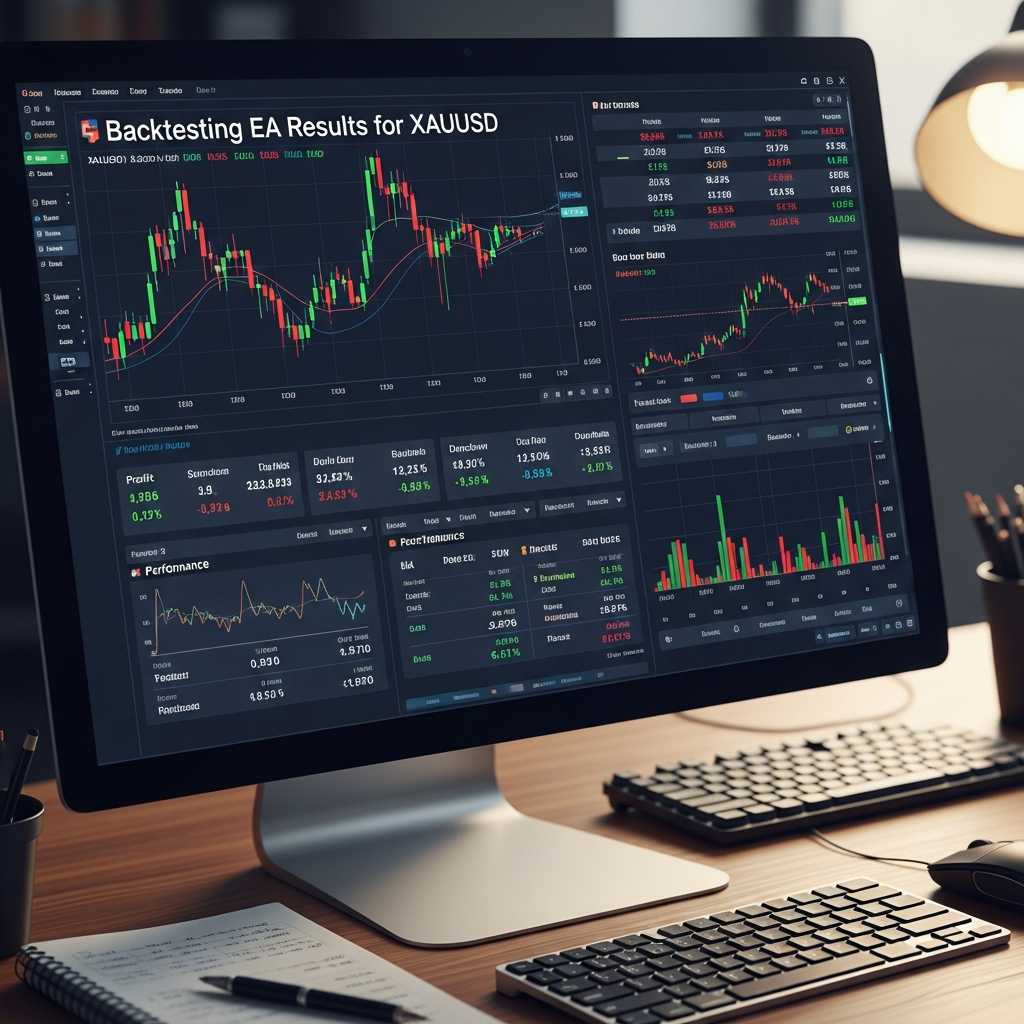
The Evolution of Gold Trading in the Algorithmic Era
Gold (XAUUSD) remains the crown jewel of the financial markets. For centuries, it has served as a hedge against inflation and a safe haven during geopolitical strife. However, as we navigate through 2026, the landscape of gold trading has transformed significantly. The market is no longer just a battleground for institutional banks and retail speculators; it is a high-speed arena dominated by sophisticated Expert Advisors (EAs). For any trader looking to deploy an automated strategy on XAUUSD, the difference between success and a blown account often boils down to one critical process: rigorous backtesting.
Backtesting is the backbone of algorithmic trading. It allows you to simulate how your trading robot would have performed in the past using historical data. But when it comes to XAUUSD, a simple backtest is rarely enough. The unique volatility of gold, coupled with the precision required to navigate its intraday swings, demands a specialized approach. In this guide, we will break down the essential steps to verifying EA results for XAUUSD, ensuring your 2026 trading strategy is built on a foundation of data rather than hope.
Why XAUUSD Backtesting Requires a Specialized Approach
Trading gold is fundamentally different from trading major currency pairs like EURUSD or USDJPY. Gold is a commodity, and its price action is driven by a unique cocktail of interest rate expectations, dollar strength, and global risk sentiment. These factors often lead to “fat-tail” events—large, sudden moves that can wipe out an inadequately tested EA.
The Volatility Factor
XAUUSD is known for its high Average True Range (ATR). During news releases or sessions overlaps, gold can move hundreds of pips in seconds. If your backtesting environment doesn’t account for variable spreads or the lack of liquidity during these spikes, your results will be dangerously optimistic. A strategy that looks like a money-printing machine in a standard backtest might fail instantly in a live 2026 market environment due to slippage.
Spread Sensitivity
Unlike liquid forex pairs where spreads might stay within a tight range, gold spreads can widen significantly during the rollover period or high-impact news. Many EAs that scalp small profits on XAUUSD become unprofitable the moment you introduce realistic, variable spreads into the simulation. This is why 99% modeling quality is not just a luxury; it is a requirement.
The Technical Foundation: Data Quality and Modeling
Before you even look at the profit and loss (P&L) of an EA, you must audit the quality of the data used. In 2026, the tools available for retail traders have caught up with institutional standards, but many still fall into the trap of using “standard” MT4 or MT5 historical data, which is often riddled with gaps.
Achieving 99.9% Modeling Quality
To get a realistic view of XAUUSD performance, you need tick data. Standard “M1 OHLC” (Open, High, Low, Close) data only provides four data points per minute. Tick data, however, records every single price change. This allows the backtester to simulate exactly how an EA would have reacted to a price spike or a sudden reversal. Using software like Tick Data Suite or specialized MT5 data feeds is essential for achieving the 99.9% modeling quality required to trust your results.
The Role of Commissions and Swap Rates
In the 2026 brokerage landscape, trading costs are more than just the spread. For XAUUSD, you must factor in the specific commission per lot and the swap rates (interest paid or earned for holding a position overnight). Gold swaps can be particularly heavy, especially for long positions when interest rates are high. If your backtest ignores swaps, a strategy that looks profitable over a 12-month period might actually be losing money once those daily costs are deducted.
Interpreting the Metrics: Beyond the Profit Graph
When you finish a backtest, the first thing you see is the equity curve. A smooth, upward-sloping line is addictive, but it can be deceptive. To truly understand the risk of an XAUUSD EA, you need to dive into the deeper metrics.
1. Maximum Drawdown (Relative vs. Absolute)
Drawdown is the measure of the peak-to-trough decline during a specific period. For Gold EAs, the maximum drawdown is the most important metric for psychological survival. If an EA has a 20% drawdown but offers a 100% return, it might seem acceptable. However, you must ask: can you handle a 20% drop in your capital during a gold market crash? In 2026, we see more “flash crashes” in the gold market due to high-frequency trading, making drawdown management more critical than ever.
2. Profit Factor and Expectancy
Profit factor is the ratio of gross profit to gross loss. A profit factor above 1.5 is generally considered good, while anything above 2.0 is excellent. However, on XAUUSD, look closely at the “Expectancy” per trade. This tells you how much, on average, you can expect to make on every trade after costs. If your expectancy is lower than the average spread, your strategy is one bad week away from obsolescence.
3. Recovery Factor
This is a metric that many traders overlook. It is the ratio of total net profit to the maximum drawdown. It tells you how quickly the EA can recover from its losses. A high recovery factor indicates a robust strategy that can handle the inherent volatility of gold without getting stuck in a long-term equity valley.
Identifying the Trap of Over-Optimization
One of the biggest dangers in XAUUSD EA development is “curve fitting.” This happens when a trader tweaks the EA settings so perfectly that it fits the historical data perfectly but fails the moment it hits the live market. Since gold has specific seasonal cycles and recurring patterns, it is very easy to accidentally over-optimize for a specific year.
Walk-Forward Analysis (WFA)
To combat curve fitting in 2026, professional traders use Walk-Forward Analysis. Instead of optimizing an EA on the entire five-year history of XAUUSD, you optimize it on a segment of data (e.g., Year 1) and then test it on “out-of-sample” data (e.g., the first three months of Year 2). If the EA continues to perform well on data it has never “seen” before, the likelihood of it being a robust strategy is much higher.
Monte Carlo Simulations
Another layer of validation is the Monte Carlo simulation. This technique involves shuffling the order of the trades or slightly varying the entry and exit prices to see how the strategy holds up under slightly different conditions. Since XAUUSD is prone to slippage and execution delays, a strategy that fails a Monte Carlo test is likely too fragile for live trading.
The 2026 Market Context: Why Historical Data Needs a Filter
As we look at backtesting results today, we must acknowledge that the 2026 market is different from the 2018 or even 2022 market. Central Bank Digital Currencies (CBDCs) and the increased use of gold as a reserve asset by non-Western nations have changed the liquidity profiles of XAUUSD.
Testing Against Black Swan Events
Your backtest must include periods of extreme stress. If you are testing an EA on XAUUSD, ensure your data includes the high-volatility years of 2020, 2022, and the mid-2020s geopolitical shifts. An EA that was profitable in a low-volatility environment but blows up during a 5% daily move in gold is a liability, not an asset.
The Impact of News Filters
Many modern EAs use news filters to stop trading during high-impact events like the Non-Farm Payrolls (NFP) or Federal Reserve rate decisions. When backtesting, you must ensure that your backtesting software can simulate these news filters. If your EA avoids NFP in the real world but takes those trades in the backtest, your results will be skewed. Accuracy in 2026 requires simulating not just the price, but the operational environment of the trader.
Moving from Backtest to Forward Test
Once you have a backtest that shows a stable equity curve, low drawdown, and a healthy recovery factor, you are still not ready for a large live account. The final step is the forward test, often performed on a “Cent” account or a small live account.
The goal of the forward test is to compare the live results with the backtested results for the same period. This is known as “backtest-to-live correlation.” If your live trades are consistently seeing worse fills or higher slippage than the backtest predicted, you need to go back to your modeling settings and increase the simulated slippage. In the fast-moving 2026 XAUUSD market, a 1-2 pip difference in execution can be the difference between a profitable month and a losing one.
Conclusion: Discipline in a Digital World
Backtesting an EA for XAUUSD is more than just clicking a button and waiting for a report. It is a meticulous process of data verification, stress testing, and psychological preparation. In 2026, the tools to succeed are more powerful than ever, but the market is also more efficient. To gain an edge in gold trading, you must treat your backtesting with the same professional rigor that a quant fund would.
Remember, a backtest doesn’t guarantee future results; it only provides a statistical probability of success. By focusing on 99.9% modeling quality, accounting for every hidden cost, and avoiding the lure of over-optimization, you can deploy your XAUUSD EA with the confidence that it has survived the ultimate digital stress test. In the volatile world of gold, that confidence is your most valuable asset.