
Top Neural Network Indicators for MT5 in 2026: The Ultimate AI Trading Guide
Neural Network Indicators for MT5: Navigating the 2026 AI Trading Revolution
The landscape of retail and institutional trading has undergone a seismic shift as we navigate through 2026. Traditional technical indicators like the Relative Strength Index (RSI) or Moving Average Convergence Divergence (MACD), while still useful, are increasingly viewed as foundational relics. In their place, neural network indicators for MT5 have emerged as the primary weapons for traders seeking an edge in an increasingly efficient and automated market.
As MetaTrader 5 continues to dominate the retail trading space, its integration with advanced artificial intelligence has matured. By 2026, the convergence of high-speed cloud computing and sophisticated machine learning libraries has made it possible for even independent traders to deploy deep learning architectures directly on their charts. This guide explores the state-of-the-art neural network indicators currently reshaping the MT5 ecosystem.
The Evolution of Trading Indicators in 2026
In the early 2020s, neural networks were often seen as ‘black boxes’—complex, prone to overfitting, and difficult to implement within the MQL5 environment. However, the 2026 trading environment is characterized by the widespread adoption of ONNX (Open Neural Network Exchange) and a seamless bridge between Python-based training and MQL5 execution. Modern neural network indicators are no longer just ‘indicators’; they are dynamic prediction engines that adapt to market volatility in real-time.
Why Neural Networks are Superior to Traditional Indicators
Traditional indicators are mathematically static. A 14-period RSI calculates the same way regardless of whether the market is in a low-volatility accumulation phase or a high-volatility news-driven breakout. Neural network indicators, conversely, utilize multi-layered architectures to identify non-linear relationships in data. They don’t just look at price; they analyze volume, time-of-day dynamics, and inter-market correlations simultaneously.
Top Neural Network Indicators for MT5 in 2026
As we analyze the current market leaders, several specific architectures have risen to the top of the MT5 marketplace and developer forums. These tools represent the pinnacle of algorithmic trading in 2026.
1. The Transformer-Based Price Predictor
Taking a page from Large Language Models (LLMs), the Transformer-based indicator is the gold standard for MT5 in 2026. Unlike older Recurrent Neural Networks (RNNs) that processed data sequentially, Transformers use ‘attention mechanisms’ to weigh the importance of different past price movements. This allows the indicator to recognize that a price spike three days ago might be more relevant to today’s trend than a minor fluctuation three hours ago.
2. LSTM Gated Oscillators
Long Short-Term Memory (LSTM) networks remain a favorite for swing traders. In 2026, these are frequently used to create ‘Gated Oscillators.’ These indicators filter out market noise by maintaining a ‘memory’ of previous market cycles. When the LSTM indicator signals an overbought condition, it does so by comparing the current momentum against months of learned cyclical behavior, significantly reducing the ‘fake-out’ signals common in standard oscillators.
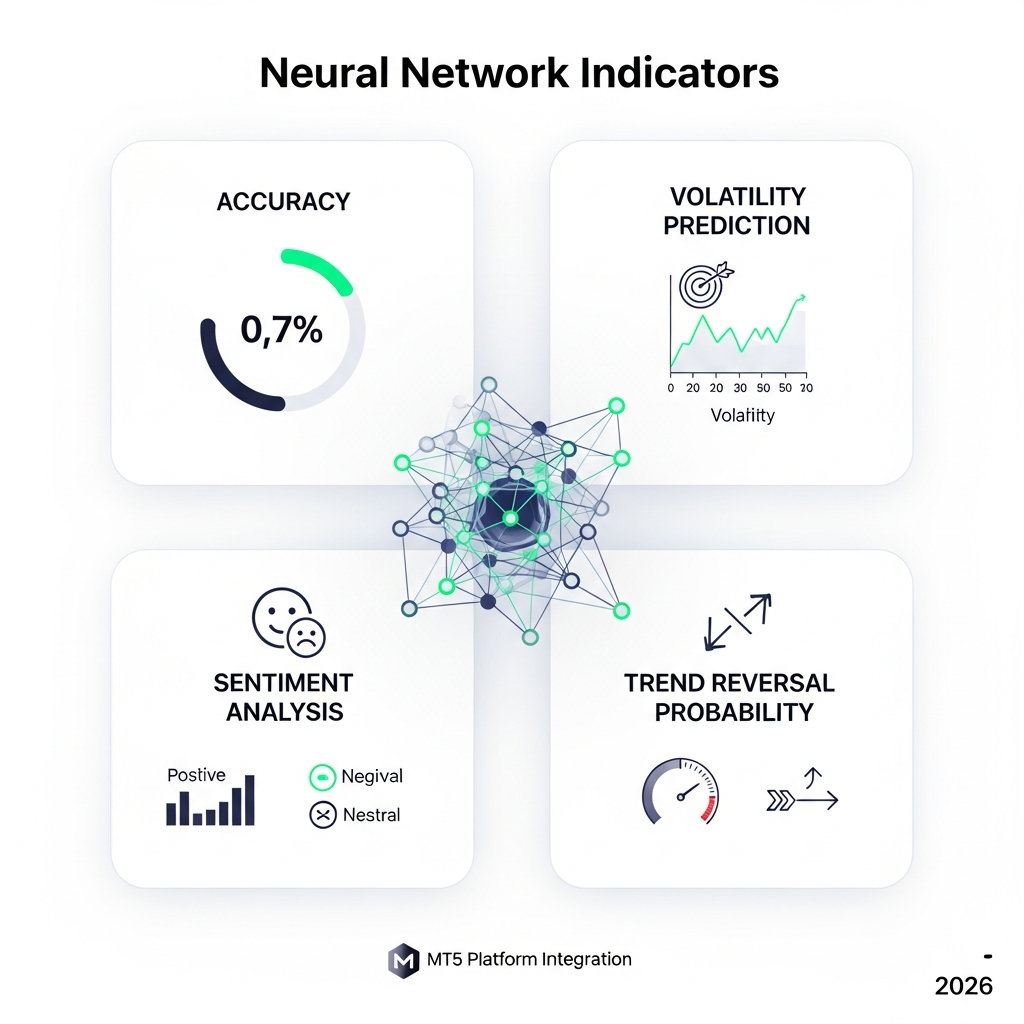
3. Sentiment-Integrated Multi-Layer Perceptrons (MLP)
One of the most significant breakthroughs in 2026 is the integration of real-time sentiment analysis into MT5 indicators. These MLPs don’t just ingest OHLC data; they connect via API to live news feeds and social media aggregates. The indicator then outputs a ‘probability score’ for a trend reversal based on both technical patterns and the current global news sentiment, providing a holistic view of the market.
How to Choose the Best Neural Indicator for Your Strategy
With thousands of AI-powered tools available, selecting the right one for your MT5 terminal requires a rigorous framework. In 2026, smart traders look for three key metrics:
- In-Sample vs. Out-of-Sample Performance: Does the indicator perform well on data it hasn’t seen before? Avoid indicators that show ‘perfect’ historical results, as this is a hallmark of overfitting.
- Latency and Execution: Neural networks can be computationally heavy. Ensure the indicator is optimized for 2026 hardware standards, ideally utilizing GPU acceleration if you are running multiple instances.
- Walk-Forward Efficiency: The best indicators in 2026 include a built-in walk-forward optimization module, allowing the network to re-train itself periodically as market regimes shift.
- Transparency Levels: While AI is complex, the best indicators provide ‘Explainable AI’ (XAI) features, showing which features (e.g., volatility, volume, or specific price levels) most influenced the current prediction.
Implementing Neural Networks in MT5: A 2026 Perspective
The technical barrier to entry has dropped significantly. In 2026, setting up a neural network indicator usually involves the following steps:
Step 1: The MQL5-Python Bridge
The native MT5 Python integration is now more robust than ever. Most high-end neural indicators use MQL5 for the user interface and trade execution, while the ‘heavy lifting’ of the neural calculations is performed in a Python environment running in the background. This allows for the use of libraries like TensorFlow 3.0 or PyTorch 2026.
Step 2: Data Pre-processing
A neural network is only as good as the data it consumes. By 2026, advanced indicators include automated data cleaning modules. These modules handle missing bars, normalize price data into stationary series (often using fractional differentiation), and remove outliers that could skew the network’s learning process.
Step 3: Model Training and ONNX Export
Many professional traders now train their models on high-performance cloud servers and export them as .onnx files. MT5 can natively run these .onnx files, allowing for institutional-grade prediction speeds on a local retail terminal.

Risk Management in the Age of AI Trading
Despite the sophistication of neural network indicators for MT5 in 2026, the fundamental rules of risk management have not changed. AI is a probabilistic tool, not a crystal ball. Even the most advanced Transformer model can be blindsided by ‘Black Swan’ events or sudden geopolitical shifts.
The Danger of Overfitting
In 2026, the most common pitfall for traders is ‘over-optimization.’ It is easy to train a neural network to perfectly predict the past year of S&P 500 movement. However, such a model is usually brittle. Traders must prioritize ‘robustness’—the ability of the model to maintain profitability across different market regimes (trending, ranging, and high-volatility).
The Role of Human Oversight
The consensus in 2026 is that ‘Centaur Trading’—the combination of human intuition and AI precision—outperforms pure AI systems. Use neural network indicators to identify high-probability setups, but maintain human control over final trade execution and overall portfolio exposure.
Future Trends: Beyond 2026
Looking toward the end of the decade, we are already seeing the first glimpses of Quantum-inspired neural networks for MT5. These indicators promise to solve optimization problems at speeds currently unthinkable. Additionally, ‘Federated Learning’ is becoming a trend, where a group of traders’ indicators can learn from collective data without sharing their proprietary strategies or private data.
Conclusion
Neural network indicators for MT5 have transitioned from a niche curiosity to an essential tool for the modern trader in 2026. Whether you are utilizing LSTM oscillators for swing trading or Transformer-based engines for day trading, the key to success lies in understanding the underlying architecture and maintaining rigorous backtesting standards. As the markets become more competitive, these AI-driven tools provide the edge necessary to navigate the complexities of global finance.
Start your journey into AI trading today by exploring the MQL5 Market’s ‘Neural’ category, but always remember: the best indicator is the one that fits your personal risk profile and trading psychology.